Digitizing film is easier when your scanner can reduce dust and scratch artifacts during capture. The right model can save substantial cleanup time while preserving detail, color, and tonal range.
This roundup compares 10 options for photographers, families, and archival projects, from dedicated 35mm scanners to versatile flatbeds and simple standalone converters.
Best 10 Film Scanners with Dust Removal Picks for 2026
High-Resolution 35mm Pick

- 7200 dpi scanning for 35mm film
- Infrared dust and scratch detection
- SilverFast SE Plus 9 included
Best For: 35mm film archivists seeking detailed scans
Professional Flatbed Classic

- 4,800 x 9,600 dpi optical resolution
- Built-in transparency adapter and film holders
- USB and FireWire connectivity
Best For: Film, slide, and print scanning on a flatbed
Fast Dust-Removal Specialist

- 38% stated scan-speed increase
- Infrared removal via SilverFast iSRD
- 7200 dpi and Multi-Exposure support
Best For: Fast 35mm archiving with automated defect removal
Versatile Flatbed Value

- DIGITAL ICE dust and scratch removal
- Scans 35mm and medium-format film
- Also handles prints and documents
Best For: Home users needing broad media compatibility
Professional Dust Removal Pick
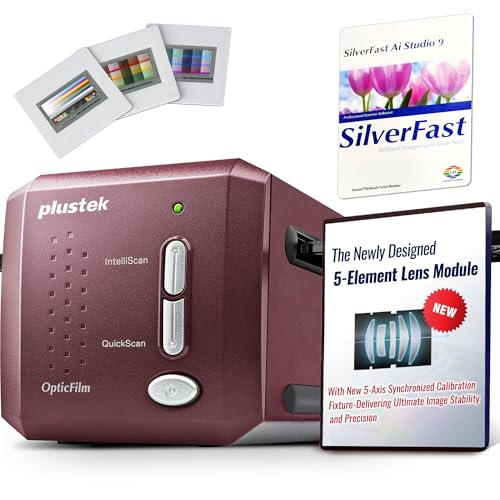
- 7200 dpi optical resolution for detailed 35mm scans
- Infrared SilverFast iSRD dust and scratch removal
- Five-axis calibration and IT8 color target included
Best For: Professional 35mm film digitization and restoration
Versatile Legacy Photo Scanner
Epson Perfection 4990 Photo Scanner

- Digital ICE technology for dust and defect correction
- Adapters support film strips, slides, medium format, and 4-by-5 film
- 4,800 x 9,600 dpi with 48-bit color
Best For: Mixed-format home archives and photo collections
Easy LCD Film Digitizer
KODAK Slide N Scan Film Scanner

- 5-inch LCD for previewing and gallery viewing
- Handles 135, 110, 126 film and 50mm slides
- Saves scans directly to an SD or SDHC card
Best For: Casual home users digitizing common slides and negatives
High-Resolution Restoration Pick

- 6400 dpi optical resolution
- Digital ICE dust and scratch reduction
- Scans film, photos, and documents
Best For: Detailed home archiving and photo restoration
Fast Standalone Converter

- 24MP JPEG film and slide conversion
- Built-in 5-inch LCD display
- Computer-free SD-card storage
Best For: Quick, simple digitizing across multiple film formats
Classic Dedicated Film Scanner

- 2,900 dpi optical resolution
- Color Management System for color matching
- LED light source and 3.6 dynamic range
Best For: Computer-based film and slide scanning with color consistency
High-Resolution 35mm Pick – Plustek OpticFilm 8200i SE
For photographers focused on 35mm negatives and mounted slides, the Plustek OpticFilm 8200i SE is a strong choice among film scanners with dust removal. Its built-in infrared channel helps detect dust and scratches, while 7200 dpi scanning and bundled SilverFast SE Plus 9 support detailed digital files.
Best For: 35mm film users who want high resolution, infrared defect detection, and Mac or Windows compatibility.
Pros:
- Built-in infrared channel detects dust and scratches for software-assisted removal.
- 7200 x 7200 dpi resolution and 48-bit input support detailed scans.
- Includes SilverFast SE Plus 9 and Plustek QuickScan software.
- Supports Windows 7 through 11 and Mac OS 10.7 through 14.x.
Cons:
- Designed for 35mm negatives and mounted slides rather than larger film formats.
- Uses a USB connection.
The 8200i SE makes the most sense when scan detail and automated dust and scratch correction matter more than scanning versatility. Its 35mm-only focus keeps the feature set targeted for film archiving.
Professional Flatbed Classic – Epson Perfection 4870 PRO
The Epson Perfection 4870 PRO combines a flatbed design with a built-in transparency adapter and film holders. For shoppers comparing film scanners with dust removal, its professional software bundle and 48-bit color depth make it a capable option for scanning negatives, slides, and photos.
Best For: Users who need a flatbed scanner for film, slides, and photographic prints with legacy USB or FireWire connectivity.
Pros:
- Offers 4,800 x 9,600 dpi optical resolution.
- Built-in transparency adapter includes four film holders.
- Provides 48-bit color and 16-bit grayscale depth.
- Supports USB 2.0 and FireWire connections and includes SilverFast Ai 6.0.
Cons:
- Its listed operating-system support includes older platforms.
- At 15 pounds, it is relatively heavy for a photo scanner.
- The supplied notes do not specify built-in infrared dust-removal hardware.
The 4870 PRO is better suited to buyers who value flatbed flexibility and broad media handling than to those seeking the newest dedicated infrared cleaning system. Check computer compatibility carefully before buying.
Fast Dust-Removal Specialist – Plustek OpticFilm 8300i SE
The Plustek OpticFilm 8300i SE is a dedicated 35mm scanner built for efficient archiving. Its infrared channel works with SilverFast iSRD to detect and remove dust and scratches, while the listed 38% scan-speed increase can help when processing a larger film collection.
Best For: 35mm negative and slide owners who want automated defect removal, professional scanning software, and faster workflow performance.
Pros:
- Built-in infrared channel supports SilverFast iSRD dust and scratch removal.
- Scans at up to 7200 x 7200 dpi with up to 3.91 Dmax using Multi-Exposure.
- Includes SilverFast SE Plus 9 and Plustek QuickScan Plus.
- Advertises a 38% scan-speed increase over the prior model.
Cons:
- Focused on 35mm film and slides rather than medium-format film.
- Uses USB connectivity.
- The supplied Mac compatibility range is listed through macOS 12.x.
Choose the 8300i SE when a dedicated 35mm workflow and automated dust correction are priorities. It offers a particularly strong combination of high resolution, software tools, and stated speed improvements.
Versatile Flatbed Value – Epson Perfection V600 Photo
The Epson Perfection V600 Photo is a flexible option for shoppers seeking film scanners with dust removal alongside everyday photo and document scanning. Its built-in Transparency Unit handles 35mm and medium-format film, while DIGITAL ICE technology helps remove dust and scratches from scans.
Best For: Home archivists who need to scan 35mm film, mounted slides, medium-format film, prints, and documents with one device.
Pros:
- DIGITAL ICE technology provides dust and scratch removal.
- Scans 35mm, mounted slides, and medium-format film up to 6 x 22 cm.
- Offers up to 6400 x 9600 dpi and supports enlargements up to 17 x 22 inches.
- Includes four customizable buttons and USB 2.0 connectivity.
Cons:
- Its flatbed design may be less specialized for high-volume 35mm scanning.
- Uses a wired USB connection.
- The listed minimum system requirement is Windows 7.
The V600 stands out for versatility rather than dedicated film-only performance. It is a practical fit when dust and scratch correction, medium-format support, and print scanning are all important.
Professional Dust Removal Pick – Plustek OpticFilm 9000i Ai
The Plustek OpticFilm 9000i Ai is a premium choice among film scanners with dust removal, combining infrared defect detection with SilverFast iSRD technology. Its 7200 dpi optical resolution, five-axis calibration, and included IT8 target make it suited to detail-focused 35mm digitization.
Best For: Photographers, studios, and serious film enthusiasts who want high-resolution 35mm scans with automated dust and scratch reduction.
Pros:
- Infrared channel and SilverFast iSRD help remove dust and scratches.
- 7200 dpi optical resolution captures fine grain and detail.
- Five-axis factory calibration supports consistent focus and alignment.
- Includes SilverFast Ai Studio, QuickScan Plus, and an IT8 calibration target.
Cons:
- Designed for 35mm negatives and slides rather than larger film formats.
- Requires Windows 7 or later 64-bit systems or macOS 10.14 and later.
- Its professional feature set may be more than casual users need.
Choose this model when restoration quality, color calibration, and repeatable results matter more than keeping the setup simple. The infrared workflow can reduce manual retouching during demanding digitization projects.
Versatile Legacy Photo Scanner – Epson Perfection 4990 Photo Scanner
The Epson Perfection 4990 is a flexible option for shoppers comparing film scanners with dust removal and broader photo-scanning support. It combines Digital ICE technology with adapters for slides, film strips, medium format, and 4-by-5 film.
Best For: Users digitizing a mixed collection of photos, slides, film strips, medium-format film, and 4-by-5 originals.
Pros:
- Digital ICE technology is included for dust and defect correction.
- Supports slides, film strips, medium format, and 4-by-5 film.
- Offers 4,800 x 9,600 dpi resolution and 48-bit color.
- Includes Epson Easy Photo Fix and SilverFast SE 6 software.
Cons:
- It is an older model with Windows 7 listed as the minimum system requirement.
- At 19.6 pounds, it is substantially heavier than compact film scanners.
- Connectivity is listed as USB 2.0 and FireWire.
This Epson makes the most sense when format flexibility is a priority. Its Digital ICE support and included adapters offer a practical way to handle varied archives, although its older interfaces and large footprint may suit a dedicated workstation best.
Easy LCD Film Digitizer – KODAK Slide N Scan Film Scanner
The KODAK Slide N Scan is a straightforward choice for converting common negatives and slides without a computer-heavy workflow. It previews images on a 5-inch LCD, applies simple capture adjustments, and saves files directly to an SD card.
Best For: Families and casual users who want convenient digitization of 135, 110, 126, and 50mm film and slides.
Pros:
- Large 5-inch LCD allows immediate previewing and gallery viewing.
- Supports 135, 110, and 126 film plus 50mm slides.
- Saves digital files directly to an SD or SDHC card up to 32GB.
- Includes film adapters, cleaning brush, USB cable, and HDMI cable.
Cons:
- The supplied notes do not specify dedicated infrared dust or scratch removal.
- SD or SDHC storage is not included.
- Its 24-bit color depth is less oriented toward professional archival work.
This model emphasizes ease of use rather than advanced restoration. It is a convenient fit for viewing and sharing family memories, but users specifically seeking automated dust removal should consider a scanner with explicitly stated infrared correction.
High-Resolution Restoration Pick – Epson Perfection V550
For buyers seeking film scanners with dust removal, the Epson Perfection V550 combines 6400 dpi optical resolution with Digital ICE technology designed to reduce the appearance of dust and scratches on film. Its built-in transparency unit supports 35mm slides, negatives, and film, while the flatbed design also handles photos and documents.
Best For: Home archivists who want detailed scans, film cleanup, and a versatile photo-and-document scanner.
Pros:
- 6400 dpi optical resolution supports enlargements up to 17 x 22 inches.
- Digital ICE technology removes the appearance of dust and scratches on film.
- Scans multiple photos at once with automatic edge detection and separate file saving.
- ReadyScan LED technology requires no warm-up time or mercury.
Cons:
- At 9.6 pounds, it is less portable than compact film-only scanners.
- Uses a USB connection rather than standalone memory-card operation.
The V550 is the strongest all-around choice here for users who prioritize resolution and restoration features. Its flatbed format adds flexibility, though it takes more space and involves computer-based scanning.
Fast Standalone Converter – Magnasonic FS71
The Magnasonic FS71 is a convenient option for buyers comparing film scanners with dust removal features who want quick, computer-free digitizing. It converts several film and slide formats into 24MP JPEG files, with brightness and RGB color adjustments available directly on the scanner.
Best For: Users who want fast transfers, a built-in display, and simple SD-card storage without installing scanner software.
Pros:
- Supports 35mm, 110, 126, and Super 8 film plus 135, 126, and 110 slides.
- Scans photos in less than 5 seconds each with included fast-loading trays.
- 5-inch LCD allows direct viewing, while HDMI supports display on a TV or monitor.
- Saves JPEG files to an SD card with support for up to 128GB.
Cons:
- The supplied notes do not list a dedicated dust- or scratch-removal feature.
- SD card and HDMI cable are not included.
- Its 24-bit color depth and 24MP output offer less stated scanning detail than the Epson V550.
The FS71 emphasizes speed and convenience rather than advanced restoration. It is a practical fit for large batches and varied film formats, but buyers specifically seeking automated dust removal should consider the Epson instead.
Classic Dedicated Film Scanner – Nikon Coolscan IV ED
The Nikon Coolscan IV ED is a dedicated USB film scanner for buyers who value consistent color and straightforward computer connectivity. Its 2,900 dpi optical resolution, 3.6 dynamic range, and LED light source are geared toward detail across a broad range of tones, although the supplied notes do not identify a dust-removal system.
Best For: Film and slide users who want a dedicated Nikon scanner with color management and a stated 42-second scan time.
Pros:
- 2,900 dpi optical resolution provides detailed film scans.
- Color Management System is designed for vivid, accurate color matching.
- 3.6 dynamic range supports detail across a wide range of tones.
- LED lighting supports consistent color performance.
Cons:
- The supplied notes do not list dust- or scratch-removal technology.
- USB connectivity requires use with a computer.
- The listed details show 24-bit color depth, below the Epson V550’s 48-bit specification.
The Coolscan IV ED remains a focused option for scanning film and slides with color consistency in mind. It is less suitable if automated dust removal or standalone operation is a priority, but its dedicated design and dynamic-range specification may appeal to traditional archival workflows.
How We Picked These Film Scanners with Dust Removal
We focused on scanners and film converters that offer a practical way to reduce dust, scratches, or other surface defects during digitization. The selection includes dedicated 35mm film scanners, flatbed photo scanners with film holders, legacy models still valued for image quality, and standalone devices designed for speed and convenience.
We also considered optical resolution, supported film formats, output quality, software compatibility, connection type, scanning workflow, and whether a model is better suited to occasional family archives or demanding photographic work. Advertised resolution is only one factor: optics, alignment, dynamic range, and software can have a greater effect on the final image.
Quick Comparison
| Best For | What to Look For | Typical Strength |
|---|---|---|
| 35mm negatives and slides | Dedicated film path, infrared cleaning, precise holders | Higher detail and more consistent framing |
| Mixed photo and film collections | Flatbed design, multiple film holders, large platen | Versatility for prints, documents, and transparencies |
| Fast family archiving | Simple controls, LCD preview, broad format support | Convenience and minimal computer setup |
| Professional restoration | High dynamic range, accurate alignment, advanced software | Greater control over difficult originals |
Key Buying Factors for Film Scanners with Dust Removal
Dust and Scratch Correction
Infrared-based systems can identify many surface defects on compatible color film and automatically reduce them. They are not a substitute for cleaning the film, and effectiveness can vary with black-and-white, Kodachrome, or other specialized film types. Check software support and compatibility before buying.
Resolution and Real-World Detail
High optical resolution is useful when you plan to crop, print, or enlarge images, but maximum advertised numbers do not always represent usable detail. Dedicated film scanners generally make better use of their resolution than multipurpose devices, while flatbeds provide more flexibility.
Film Formats and Holders
Confirm whether you need 35mm strips, mounted slides, 110, 126, 127, or Super 8 support. Holder quality matters because uneven film can cause softness, cropping, or inconsistent scans. A scanner limited to 35mm may deliver better results for that format than a broadly compatible converter.
Workflow and Software
Consider batch capacity, preview speed, USB requirements, operating-system compatibility, and included scanning software. Advanced software offers more control but has a steeper learning curve; standalone scanners are faster to operate for casual projects but may provide fewer restoration tools.
Who Should Buy Which Film Scanners with Dust Removal?
Choose a dedicated Plustek or Nikon film scanner if your priority is high-quality 35mm negatives and slides, repeatable framing, and detailed editing. Select an Epson flatbed if your collection includes prints, documents, medium-format originals, or mixed-size transparencies. Older Epson and Nikon models can be worthwhile when verified working and supported by compatible drivers, but account for their age and connectivity.
For quick, approachable digitization without a traditional computer-based workflow, consider a Kodak or Magnasonic all-in-one unit. These are convenient for family archives and sharing, while photographers seeking large prints or extensive editing should favor a dedicated scanner with stronger optics, better software, and infrared dust correction.