Old negatives and slides can hold irreplaceable memories, but aging film is vulnerable to scratches, fading, and loss. The right scanner makes it easier to preserve those images as shareable digital files without sending every frame to a lab.
This roundup compares 10 film scanners for digitizing photos, covering compact 35mm models, multi-format scanners, and photo-capable options for larger family archives. We focus on compatibility, resolution, ease of use, display quality, and workflow convenience.
Best 10 Film Scanners for Digitizing Photos Picks for 2026
Best for Easy Home Archiving

- Supports 135, 110, 126, and 50mm formats
- 5-inch LCD with gallery mode
- One-touch editing and SD card saving
Best For: Mixed home collections and simple standalone scanning
Best for Touchscreen Simplicity

- Standalone operation without a computer
- 5-inch all-angle touchscreen
- Supports 135, 126, and 110 formats
Best For: Hands-on scanning and mixed-format archives
Best for Fast High-Resolution Scans

- 24MP JPEG output with fast scanning
- Supports 35mm, Super 8, 110, and 126 formats
- SD storage supports up to 128GB
Best For: Large collections and quick computer-free scanning
Best for Large Previewing

- Large tiltable 7-inch LCD
- Quick-feeding tray for continuous scanning
- Supports 135, 110, and 126 film
Best For: Large-screen previewing and family slide archives
Best All-Around Pick

- 24MP scanning with a 1/2.3-inch CMOS sensor
- 7-inch LCD and one-touch controls
- Supports several film and slide formats; SD card included
Best For: Mixed film and slide collections
Best for Photos and Film
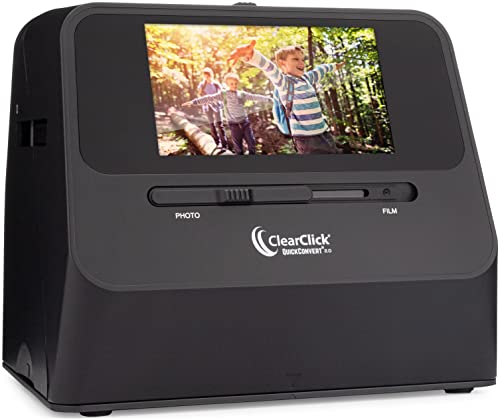
- Handles 4x6 photos and several film formats
- Rechargeable battery supports cordless scanning
- 5-inch preview LCD and two-year warranty
Best For: 4x6 photos plus 35mm, 110, or 126 film
Best Compact Film-Only Option
KODAK SCANZA Film & Slide Scanner
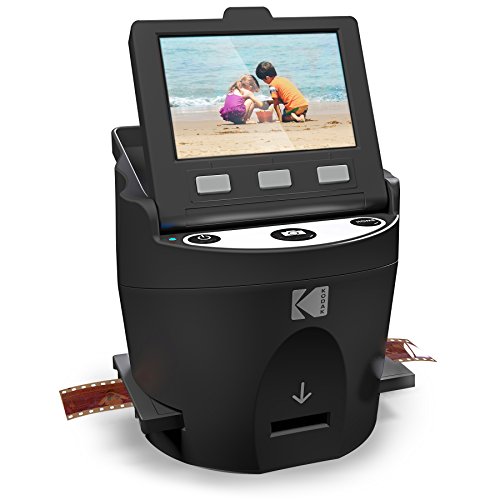
- Supports 35mm, 126, 110, Super 8, and 8mm
- 14MP scans with 22MP interpolation
- Multiple adapters, cables, and cleaning brush included
Best For: Compact scanning of supported film formats
Best All-in-One Kit

- Supports 135/110/126 and Super 8 formats
- 5-inch LCD with Gallery Mode
- Includes HDMI, USB-C, and five adapters
Best For: Families digitizing varied film and slide collections
Best for Built-In Storage

- Includes 128MB built-in memory
- Supports 35mm, 110, 126, 50mm, and Super 8
- 5-inch LCD with HDMI and USB output
Best For: Beginners wanting simple scanning and initial storage
Best Compact Option
ClearScan MINI 16MP Film Scanner

- Lightweight 10.08-ounce portable design
- 16MP CMOS sensor with on-device editing
- Scans 126 and 135 film to SD card
Best For: Portable scanning of smaller 126 and 135 film collections
Best for Easy Home Archiving – KODAK Slide N Scan 22MP
For shoppers comparing film scanners for digitizing photos, the KODAK Slide N Scan offers a convenient standalone setup with a large 5-inch LCD, one-touch adjustments, and direct saving to an SD or SDHC card. It supports 135, 110, and 126 negatives plus 50mm slides.
Best For: Families digitizing mixed slide and negative collections without a complicated computer-based workflow.
Pros:
- Supports 135, 110, and 126 negatives and 50mm slides.
- Large 5-inch LCD includes gallery viewing and preview editing.
- Quick-feeding trays and one-touch controls simplify scanning.
- Includes USB and HDMI cables plus multiple film adapters.
Cons:
- SD or SDHC card is required but not included.
- Compatible memory capacity is limited to 32GB.
- Its editing controls are designed for simple adjustments rather than advanced photo editing.
The broad format support and included accessories make this a practical choice for casual home archiving. Its LCD and gallery mode are also useful when you want to preview or share scans directly from the unit.
Best for Touchscreen Simplicity – HP FilmScan HPFS500
The HP FilmScan HPFS500 is a straightforward option among film scanners for digitizing photos, using a standalone workflow that does not require a computer. Its 5-inch touchscreen lets you preview and edit scans, while the quick-load tray helps move through larger collections.
Best For: Users who want hands-on touchscreen control and support for several common film formats.
Pros:
- Works as a standalone scanner without a computer during digitization.
- Supports 135, 126, and 110 negatives and positive slides.
- 5-inch all-angle LCD touchscreen provides direct preview and editing.
- Quick-load tray supports more efficient batch scanning.
Cons:
- Its 13MP CMOS sensor uses 22MP interpolation rather than a native 22MP sensor.
- Saving scans requires SD card media.
- Listed computer compatibility starts at Windows 10 or macOS 10.15.
This HP model emphasizes ease of use over complicated software workflows. The touchscreen and format coverage should appeal to anyone organizing a mixed archive and wanting to make adjustments directly on the scanner.
Best for Fast High-Resolution Scans – Magnasonic FS71 24MP
For buyers seeking film scanners for digitizing photos quickly, the Magnasonic FS71 combines 24MP JPEG output with a fast-loading tray and scans that can take less than five seconds each. It handles 35mm, 110, 126, and Super 8 negatives, along with 135, 126, and 110 slides.
Best For: Users who want quick scanning, broad format support, and direct image adjustments without a computer.
Pros:
- Converts several negative and slide formats into 24MP JPEG files.
- Scans photos in less than five seconds each according to the supplied specifications.
- Built-in controls adjust brightness, RGB color, orientation, and mirroring.
- SD card slot supports up to 128GB of expandable memory.
Cons:
- SD card is not included.
- HDMI cable is not included for TV or monitor viewing.
- Its direct editing tools may not replace full desktop photo-editing software.
The FS71 stands out for speed and storage flexibility, making it well suited to sizable home collections. Its 5-inch display and computer-free controls keep the process accessible while preserving useful adjustment options.
Best for Large Previewing – KODAK Slide N Scan Max 7-Inch
The KODAK Slide N Scan Max is a useful choice for film scanners for digitizing photos when a larger preview screen matters. Its tiltable 7-inch LCD doubles as a digital picture frame, while the quick-feeding tray and direct SD/SDHC saving support a smooth home-archiving workflow.
Best For: Users who prioritize a large viewing screen and simple scanning of 135, 110, and 126 film.
Pros:
- 7-inch tiltable LCD provides an expansive preview and editing area.
- Quick-feeding tray supports continuous scanning without repositioning every frame.
- Handles 135, 110, and 126 film formats.
- One-touch editing simplifies resizing, conversion, and image adjustments.
Cons:
- SD or SDHC card is required and limited to 32GB.
- It does not list HDMI connectivity in the supplied details.
- The supplied specifications identify 3200 dpi resolution but do not state a megapixel output.
The Max model is especially appealing for users who want to inspect scans on a larger built-in display. Its continuous-feed design and straightforward controls make it a practical option for family slide and negative projects.
Best All-Around Pick – BEONEGLOBAL ClearScan P7
For shoppers comparing film scanners for digitizing photos, the BEONEGLOBAL ClearScan P7 stands out for its large display, broad film compatibility, and simple controls. It scans to JPEG without a computer and includes an SD card for getting started immediately.
Best For: Families digitizing mixed collections of slides and film with a clear, easy-to-use interface.
Pros:
- Supports 35mm, 135, 126, 110, Super 8, and 8mm film and slides.
- Uses a 1/2.3-inch CMOS sensor for scans up to 24MP.
- Large 7-inch LCD makes previews and adjustments easier to view.
- Includes a branded SD card and requires no computer for scanning.
Cons:
- Does not include an automatic feeder, so media is scanned individually.
- The unit is designed for film and slides rather than larger photo prints.
The adjustable image-size function and one-touch controls add convenience, while the included SD card reduces setup friction. It is a practical choice when ease of use and wide format support matter more than automated batch scanning.
Best for Photos and Film – ClearClick QuickConvert 2.0
The ClearClick QuickConvert 2.0 is a flexible option for film scanners for digitizing photos because it handles both film and 4×6 photos. It saves JPEG files to an SD card, works without a computer, and can scan individual items in about 2–3 seconds.
Best For: Users digitizing 4×6 photos alongside 35mm, 110, and 126 film or negatives.
Pros:
- Scans 4×6 photos or smaller, plus 35mm, 110, and 126 media.
- Built-in rechargeable battery enables cord-free scanning.
- 5-inch preview LCD provides instant viewing.
- Two-year warranty and technical support are included.
Cons:
- Does not support 5×7 photos.
- Items must be scanned one at a time; there is no automatic feeder.
- The 22MP figure is interpolated, while the listed native scan resolution is 14MP.
Its rechargeable battery and album-friendly design make the QuickConvert 2.0 convenient for casual home projects. The main limitation is its narrower photo-size support, so confirm that your prints are 4×6 or smaller before buying.
Best Compact Film-Only Option – KODAK SCANZA Film & Slide Scanner
The KODAK SCANZA is a compact choice among film scanners for digitizing photos, with support for common formats including 35mm, 126, 110, Super 8, and 8mm. It converts negatives and slides to JPEG files and includes multiple adapters for switching between media.
Best For: Film-focused users who want broad format support and a compact scanner with physical controls.
Pros:
- Supports 35mm, 126, 110, Super 8, and 8mm negatives and slides.
- Offers 14MP scanning with 22MP interpolation.
- Includes multiple film inserts, adapters, and a 3.5-inch adjustable LCD.
- Comes with USB, HDMI, AC, and video cables plus a film-cleaning brush.
Cons:
- SD card is not included.
- It does not support film formats beyond those specifically listed.
- The smaller 3.5-inch screen provides less viewing area than larger-screen alternatives.
The SCANZA keeps the process straightforward with large one-touch buttons and included format adapters. It is especially useful for varied film collections, but buyers should budget for an SD card and verify that their film types are supported.
Best All-in-One Kit – 22MP Film & Slide Scanner
If you want film scanners for digitizing photos with minimal computer setup, this 22MP model offers one-touch JPEG scanning, a large preview screen, and broad format support. It handles 135/110 negatives plus 135/110/126 and Super 8 slides, with files saved to a separately purchased SD card.
Best For: Families digitizing mixed film and slide collections while previewing memories on the scanner or a TV.
Pros:
- Supports several negative and slide formats, including Super 8 slides.
- Large 5-inch LCD with editing controls and Gallery Mode.
- Includes HDMI and USB-C cables, five film adapters, and a 36-month warranty.
- Scans directly to a compatible SD card and exports to PC or Mac.
Cons:
- SD card is not included.
- Must remain connected to power during use.
- Requires manual adjustments for color and brightness when needed.
Its combination of format flexibility, built-in viewing, and included accessories makes it a practical choice for larger family archives. The 5-inch display and HDMI output are especially useful for reviewing or sharing scans without relying only on a computer.
Best for Built-In Storage – 22MP Film & Slide Scanner
For shoppers comparing film scanners for digitizing photos, this 22MP scanner combines one-touch operation with a 5-inch LCD and support for several common formats. It can save scans to 128MB of built-in memory or an optional SD card, making it convenient for short scanning sessions before transferring files.
Best For: Beginners who want simple controls, built-in storage, and direct HDMI or USB connectivity.
Pros:
- Supports 35mm/135, 110, 126, 50mm slides, and Super 8 film.
- Built-in 128MB memory provides storage without an SD card for initial use.
- 5-inch LCD supports preview, playback, and digital-frame use.
- Includes film holders, HDMI and USB cables, a power adapter, and cleaning brush.
Cons:
- External SD card is not included.
- Built-in memory is limited to 128MB.
- The supplied notes list conflicting warranty terms: 12 months in the features and 3 years in the details.
This model is well suited to straightforward home scanning, especially if you value immediate previews and the option to begin without buying a memory card. Its broad format coverage also helps when one collection includes multiple generations of film.
Best Compact Option – ClearScan MINI 16MP Film Scanner
If portability matters when choosing film scanners for digitizing photos, the BEONEGLOBAL ClearScan MINI is a lightweight option for 126 and 135 film. Its 16MP CMOS sensor, front-facing controls, and direct SD-card saving keep the scanning process simple without requiring a computer for basic use.
Best For: Users who want a compact, travel-friendly scanner for 126 and 135 film and slides.
Pros:
- Compact 10.08-ounce design is easy to carry.
- 16MP CMOS sensor and 24-bit color depth support detailed scans.
- On-device controls adjust brightness, color, rotation, and flipping.
- Compatible with SD cards up to 32GB and Windows or Mac systems.
Cons:
- Supports fewer formats than the larger scanners in this roundup.
- SD card is not included.
- Uses a smaller 2.31-inch LCD screen.
The MINI prioritizes convenience over extensive format coverage and screen size. It is a sensible fit for smaller collections or users who want to scan and share 126 or 135 film without bringing a larger desktop-style unit into the workflow.
How We Picked the Best Film Scanners for Digitizing Photos
We focused on scanners that support common home-archiving formats, including 35mm negatives and slides, 110 and 126 film, and—in some cases—Super 8 or 8mm film. We also considered advertised optical or interpolated resolution, preview-screen size, file transfer options, included holders, and whether the scanner works without a computer.
Because specifications and included accessories can vary by seller or package, confirm the current listing before buying. Resolution claims are not always directly comparable, so practical workflow and image quality matter as much as the largest stated megapixel number.
Quick Comparison
- Best for a straightforward setup: Choose a compact scanner with an integrated screen, simple controls, and direct memory-card or USB export.
- Best for mixed film collections: Look for support for 35mm, 110, 126, and specialty formats such as Super 8 or 8mm.
- Best for viewing and sharing: Larger screens and HDMI output make it easier to review scans or display them on a television.
- Best for printed photos: Select a model specifically designed to scan 4×6-inch photographs as well as film.
- Best for occasional use: A smaller, lower-cost scanner may be sufficient if you only need to preserve a few rolls.
Key Buying Factors
Film-Format Compatibility
Start with the formats in your collection. Most home users need 35mm support, while inherited archives may also include 110, 126, Super 8, or 8mm film. A scanner that includes the correct trays can save time and prevent improvised handling.
Resolution and Image Quality
Higher advertised megapixels can provide more flexibility for cropping, but they do not guarantee better scans. Look for clean illumination, accurate color reproduction, dust-free handling, and adjustable exposure or color controls. For important originals, retain the highest-quality files available before making edited copies.
Workflow and Storage
Computer-free scanning is convenient for large batches, especially when files save to a memory card. USB connectivity can simplify transfers, while HDMI is useful for reviewing images on a larger display. Check the supported card type, file format, power requirements, and whether a card is included.
Screen and Handling
A larger LCD makes it easier to position film and identify frames, while compact screens keep the scanner portable. Examine the tray design, included adapters, scan speed, and ease of cleaning. A reliable holder is particularly important for curled or fragile film.
Who Should Buy Which Film Scanners for Digitizing Photos?
Choose a basic 35mm scanner if your archive is small and you want the simplest path to digital files. A multi-format model is a better fit for families with several generations of negatives, slides, or movie film. If you want to digitize both film and physical prints, prioritize a photo-capable scanner rather than relying on an adapter.
For valuable originals or professional printing, these home scanners may not replace a dedicated camera-scanning setup or professional lab service. For everyday preservation, sharing, and backup, however, the best Film Scanners for Digitizing Photos can provide a practical balance of speed, control, and cost.