A powerful laptop can throttle under sustained gaming, rendering, or other demanding workloads when heat builds faster than its internal fans can remove it. A well-designed cooling pad can improve airflow, raise the chassis for a more comfortable angle, and help maintain steadier performance.
This roundup compares 10 options ranging from sealed-foam turbo-fan models to adjustable RGB stands and sensor-controlled notebook coolers. Focus on your laptop’s size, cooling demands, noise tolerance, and preferred controls before choosing.
Best 10 Laptop Cooling Pad with Sealed Foam Chamber Picks for 2026
Best for Temperature Monitoring

- 120 mm fan reaches 3500 RPM
- Sealed high-density foam airflow chamber
- Temperature sensor and four extra USB ports
Best For: Large desk setups needing airflow control
Best Value Sealed Cooling

- 4.72-inch turbofan reaches 3500 RPM
- 360-degree foam seal for 13- to 17.3-inch laptops
- Non-RGB design with physical controls
Best For: Mid-sized gaming laptops and practical setups
Best Smart Cooling Controls

- Airtight foam-sealed pressure chamber
- Automatic and custom fan curves
- Fits 14- to 18-inch laptops with USB hub
Best For: Users wanting automated cooling and software control
Best Feature-Rich Large-Laptop Pad

- 5.5-inch turbofan with sealed foam
- Dust filter and adjustable airflow
- Three USB ports and RGB lighting
Best For: Large gaming laptops and permanent desk setups
Best Long-Warranty Option
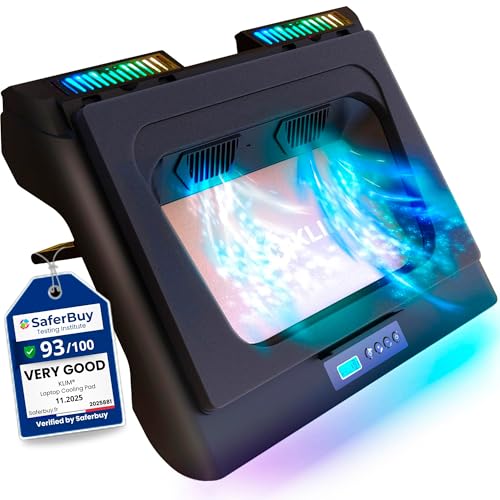
- Two 4300 RPM turbo fans
- Detachable sealed foam design
- Five-year assurance and six speeds
Best For: Compatible laptops needing adjustable cooling and long coverage
Quiet Versatile Pick
DeskLogics CP-26 Sealed Airflow Cooler

- Supports 12- to 19-inch laptops and MacBooks
- Sealed foam mode or active heat-sink mode
- 800–2600 RPM, adjustable stand, and RGB lighting
Best For: Mixed-device users seeking adaptable, quieter cooling
Best Overall Power Cooling – IETS GT600 V2 RGB
If you need a laptop cooling pad with sealed foam chamber for a large gaming notebook, the IETS GT600 V2 combines a 5.5-inch turbofan, magnetic sealing foam, and broad 14.1- to 19.3-inch compatibility. Its design is built to push hot air out quickly, though maximum fan speed can be loud.
Best For: Large gaming laptops and users who prioritize aggressive cooling, RGB lighting, and extra USB connectivity.
Pros:
- Industrial-grade 5.5-inch turbofan and sealed foam provide strong, 360-degree cooling.
- Metal construction, seven height settings, and adjustable retention features add stability.
- Includes RGB lighting, a three-port USB hub, a dust filter, and a front control panel.
Cons:
- Noise can reach 65 dB at the highest speed.
- Its 2.9-pound size and large footprint may be excessive for smaller laptops.
The GT600 V2 is a performance-first choice for demanding gaming systems, especially rear-exhaust laptops. Choose it when cooling capacity matters more than quiet operation or portability.
Best for Temperature Monitoring – Thermaltake Massive EXTREME
The Thermaltake Massive EXTREME is a laptop cooling pad with sealed foam chamber designed to contain and direct airflow around notebooks up to 18 inches. Its adjustable cross-flow fan, temperature sensor, and broad USB expansion make it a practical desk-based option.
Best For: Users who want adjustable airflow, temperature readouts, and multiple USB ports for a large laptop setup.
Pros:
- 120 mm cross-flow fan adjusts from 800 to 3500 RPM and delivers up to 48.5 CFM.
- High-density memory foam forms a sealed chamber to help direct airflow.
- Includes an ambient temperature sensor, two-stage adjustment, and four additional USB ports.
Cons:
- Its 2.27 kg weight makes it less convenient to carry.
- Plastic construction may feel less substantial than metal-bodied alternatives.
This cooler stands out for controllable airflow and useful monitoring rather than flashy features. It is a sensible match for large notebooks that stay on a workstation.
Best Value Sealed Cooling – llano V10-SE
The llano V10-SE is a laptop cooling pad with sealed foam chamber for 13- to 17.3-inch notebooks, using a 4.72-inch turbofan and 360-degree air-seal foam. This non-RGB version focuses on direct cooling, simple button controls, and a compact adjustable stand.
Best For: Gamers and heavy-workload users seeking strong sealed cooling without RGB or built-in extension ports.
Pros:
- 4.72-inch turbofan with a copper motor reaches up to 3500 RPM.
- Extra foam inserts help secure 13- to 14-inch laptops.
- Offers physical controls, three stand levels, a replaceable dust filter, and a bundled mouse pad.
Cons:
- This SE version does not include RGB lighting or extension ports.
- Compatibility is limited to laptops up to 17.3 inches; larger systems require another model.
The V10-SE is a focused cooling solution for users who prefer physical controls and no unnecessary lighting. Its sealed design and included inserts make it especially useful across a range of mid-sized gaming laptops.
Best Smart Cooling Controls – Razer Laptop Cooling Pad
Razer’s cooling pad is a laptop cooling pad with sealed foam chamber that pairs included foam seals with a 140 mm brushless fan. It automatically adjusts fan speed based on temperature settings and supports preset or custom fan curves through Razer Synapse.
Best For: Razer users and laptop owners who want automated temperature management, software controls, USB expansion, and Chroma RGB.
Pros:
- Airtight pressure chamber helps prevent cool-air leakage.
- Smart fan control, preset curves, and custom curves allow flexible noise and temperature management.
- Magnetic frames support laptops from 14 to 18 inches, with a three-port USB Type-A hub and Chroma RGB.
Cons:
- At 2.61 kg, it is better suited to a stationary desk than frequent travel.
- Some advanced controls depend on Razer Synapse software.
This is the most feature-rich option for buyers who value adaptive control over manual fan adjustment. It is particularly compelling for compatible Razer Blade systems, while the magnetic frames broaden its usefulness with other laptops.
Best High-Speed Control – IETS GT500 V1 Cooling Pad
If you need a laptop cooling pad with sealed foam chamber for demanding gaming or workstation use, the IETS GT500 V1 emphasizes high airflow and precise adjustment. Its 5000 RPM turbofan, combined sealed foam design, and bottom intake are intended to deliver broad cooling while helping prevent heat backflow on rear-exhaust laptops.
Best For: Gamers and performance users who want maximum cooling control and can tolerate substantial fan noise.
Pros:
- Infinitely variable fan speed from 0 to 5000 RPM.
- Sealed foam and 360-degree cooling help accommodate different laptop vent locations.
- Bottom air intake is designed for rear-exhaust gaming laptops.
- Includes a three-port USB hub for peripherals.
Cons:
- Noise can reach 65 dB at maximum speed.
- At 1.59 kg, it is relatively heavy for portable use.
The GT500 V1 is a performance-first choice rather than a quiet office pad. Its variable control and sealed airflow design make it appealing for intensive workloads, provided noise is not a major concern.
Best Feature-Rich Large-Laptop Pad – llano V12 Cooling Pad
The llano V12 is a laptop cooling pad with sealed foam chamber designed for larger, heavier laptops from 15.6 to 19 inches. It combines a 5.5-inch turbofan with an airtight foam seal, adjustable airflow, dust filtration, RGB lighting, and a three-port USB hub for a more complete gaming setup.
Best For: Owners of large gaming laptops who want strong cooling, peripheral connectivity, adjustable positioning, and built-in dust filtration.
Pros:
- 5.5-inch turbofan and sealed foam are designed for high-volume, all-round cooling.
- Scroll-wheel control provides quick airflow adjustment.
- Removable dust filter helps capture hair and debris before they enter the cooling system.
- Offers three USB 2.0 ports, three tilt angles, and configurable RGB lighting.
Cons:
- Its 1.8 kg weight and large footprint are not ideal for frequent travel.
- Operating noise is rated at up to 70 dB.
- The USB ports are for peripherals and not for charging devices.
With its broad laptop-size range and feature set, the V12 is more than a basic cooling stand. It is best suited to a dedicated desk setup where its size, power adapter, and higher noise level are acceptable.
Best Long-Warranty Option – KLIM Everest Cooling Pad
The KLIM Everest is a laptop cooling pad with sealed foam chamber that uses two 4300 RPM turbo fans to move air through compatible laptops. Its detachable foam seal, six fan speeds, extra USB port, and RGB lighting make it a practical option for users who want strong cooling with straightforward controls.
Best For: Users with compatible 11- to 17.3-inch laptops who value a long warranty, selectable fan speeds, and simple desk-friendly features.
Pros:
- Two 4300 RPM turbo fans and detachable foam create a sealed cooling path.
- Six fan speeds allow adjustment for different workloads.
- Includes an extra USB port for peripherals and configurable RGB lighting.
- Backed by a five-year assurance.
Cons:
- Requires ventilation openings underneath the laptop.
- Not recommended for laptops without bottom vents, including the supplied example of Apple MacBook models.
- It weighs 1.13 kg and is thicker than many basic cooling stands.
The Everest balances sealed-foam airflow with accessible controls and unusually long coverage. Check your laptop’s bottom-vent compatibility carefully before buying, since the design depends on air entering and exiting through underside openings.
Power Cooling Pick – llano V10 Turbo Fan
The llano V10 is a strong option if you want a laptop cooling pad with sealed foam chamber-style airflow management, though its supplied design emphasizes a flat-contact surface and removable dust filter rather than a sealed foam chamber. Its 4.72-inch turbo fan reaches up to 3500 RPM and is designed for 13- to 17.3-inch laptops.
Best For: Gamers and power users who want aggressive cooling, physical controls, RGB lighting, and an adjustable stand for larger laptops.
Pros:
- Large turbo fan and copper motor are rated for up to 3500 RPM.
- Supports 13- to 17.3-inch laptops, with foam inserts for smaller models.
- Offers three stand levels, a removable dust filter, RGB memory recall, and USB-A/USB-C ports.
Cons:
- The supplied notes do not specify a sealed foam chamber.
- Its single-fan design may be less appealing to shoppers seeking dual-fan cooling.
The V10 combines high airflow potential with useful desk features, making it a practical fit for demanding gaming or workstation setups. Consider it when physical controls and broad compatibility matter as much as cooling output.
Sealed-Chamber Performance Pick – IETS GT500 Turbo Fan Cooler
The IETS GT500 is the most direct match for shoppers seeking a laptop cooling pad with sealed foam chamber airflow. Its combined sealed foam and 4200 RPM industrial-grade turbofan are designed to concentrate cooling beneath compatible 13- to 17.3-inch laptops.
Best For: Performance-focused gamers who prioritize maximum adjustable cooling and need airflow directed around different laptop vent locations.
Pros:
- Combined sealed foam helps create a concentrated cooling effect.
- Infinitely variable fan speed ranges from 0 to 4200 RPM.
- Designed to address rear-exhaust heat backflow and includes a dust filter.
Cons:
- Noise can reach 55 dB at maximum speed.
- The sealed foam must be configured to the laptop’s size for the best effect.
- Its stated compatibility tops out at 17.3 inches.
The GT500 stands out when sealed airflow and raw cooling control are the priorities. Its high-speed performance comes with a clear noise trade-off, so it is better suited to gaming or heavy workloads than quiet environments.
Quiet Versatile Pick – DeskLogics CP-26 Sealed Airflow Cooler
The DeskLogics CP-26 is a flexible laptop cooling pad with sealed foam chamber-style support for gaming laptops, plus a removable seal mode for MacBooks and metal ultrabooks. Its fan runs from 800 to 2600 RPM and is designed to cool laptops from 12 to 19 inches.
Best For: Users who want one adjustable cooling stand for gaming laptops, MacBooks, and quiet everyday work.
Pros:
- Sealed memory foam can force cool air toward gaming laptop intakes.
- Removing the foam lets compatible MacBooks and ultrabooks use the pad as an active heat sink.
- Offers adjustable height, six RGB modes, a washable dust filter, and USB-C power.
Cons:
- Its maximum fan speed is lower than the IETS GT500’s 4200 RPM.
- The power adapter is not included.
- Full turbo power requires a USB 3.0 port or 5V/1A wall charger.
The CP-26 is a practical middle ground for households using different laptop types. It offers the defining sealed-airflow feature while remaining quieter and more adaptable than a high-output gaming-only cooler.
How We Picked the Best Laptop Cooling Pad with Sealed Foam Chamber
We selected models across the main categories represented in this roundup: sealed-foam turbo-fan coolers, high-airflow gaming stands, adjustable RGB pads, and feature-rich notebook coolers. We considered stated fan speed, airflow design, laptop compatibility, adjustability, controls, noise-related features, and practical fit for sustained workloads. Because manufacturer specifications can vary by configuration, treat advertised RPM and airflow as useful indicators rather than direct guarantees of temperature reduction.
A Laptop Cooling Pad with Sealed Foam Chamber is especially relevant for gaming laptops with large bottom intakes. The foam helps create a closer seal between the pad and chassis, directing more air toward the intake area instead of allowing it to escape around the edges.
Quick Comparison
| Type | Best suited to | What to prioritize |
|---|---|---|
| Sealed-foam turbo fan | High-performance gaming laptops | Intake alignment, fan control, compatible screen size |
| High-airflow cross-flow or turbo design | Long gaming and workstation sessions | Airflow rating, stability, and noise tolerance |
| Adjustable RGB cooling stand | General gaming and desk use | Height range, ergonomics, USB access, lighting controls |
| Sensor-controlled cooler | Users wanting automatic operation | Temperature sensing, control modes, and software or onboard controls |
Key Buying Factors for a Laptop Cooling Pad with Sealed Foam Chamber
Fit and Air-Seal Coverage
Check both the supported laptop range and the position of your bottom intake vents. A cooler may support a large screen size yet perform poorly if its sealed chamber does not line up with the vents. Measure the laptop’s width and depth, including any rear overhang or unusual feet.
Cooling Power and Control
Higher RPM can move more air, but it may also create more noise. Variable-speed controls are useful for balancing temperatures and acoustics, while automatic or sensor-based control can reduce unnecessary fan activity during light work. Look for a design that lets you adjust output rather than forcing one fixed speed.
Noise, Dust, and Maintenance
Turbo fans are generally more aggressive than conventional low-profile pads. Consider where you use the laptop and whether the cooler includes a filter, dust-resistant design, or accessible intake area. Keep the pad and laptop vents clear, since dust buildup can reduce the benefit of additional airflow.
Ergonomics and Connectivity
Adjustable height can improve wrist and neck comfort, but the stand should remain stable at its highest setting. Also check USB pass-through ports, power requirements, cable placement, RGB controls, and whether the pad leaves room for your preferred mouse or external keyboard setup.
Who Should Buy Which Laptop Cooling Pad with Sealed Foam Chamber?
Choose a sealed-foam turbo-fan model if you have a powerful gaming laptop, clearly positioned bottom intakes, and a priority on maximum directed airflow. Choose a conventional adjustable RGB cooler if you want a more versatile everyday stand with easier positioning and less specialized fit. A sensor-controlled option suits users who prefer automatic fan behavior, while a high-airflow cross-flow design may be the better match for large laptops or long workstation sessions. If portability and quiet operation matter most, favor a simpler, lower-speed stand over the largest turbo-fan design.