Choosing the right commercial dough mixer can improve batch consistency, reduce manual labor, and keep a bakery or restaurant moving during busy service. The models in this roundup range from compact countertop mixers to high-capacity spiral machines for demanding production.
Use the buying guide below to compare capacity, motor power, controls, construction, and installation requirements before choosing the machine that best matches your recipes and daily volume.
Best 10 Dough Kneading Machine Commercial Picks for 2026
Heavy-Duty Tilt-Bucket Mixer

- 25 kg batch capacity with a 2200W motor
- 90-degree tilt bucket for unloading and cleaning
- Two-direction mixing for dough and meat fillings
Best For: High-volume buns, dumplings, noodles, and filling preparation
Versatile Commercial Stand Mixer

- 20-quart bowl for batches up to 3 kg
- Three speeds with a 0–30 minute timer
- Includes dough hook, beater, and whisk
Best For: Commercial kitchens mixing dough, fillings, batters, and creams
All-Stainless Pizza Mixer

- 25 kg dough capacity with a 2200W motor
- Full stainless steel construction
- Tilt bowl and reverse rotation simplify unloading
Best For: Pizzerias, bakeries, and other high-volume dough operations
Compact Multi-Function Mixer

- 15-quart bowl handles up to 1.5 kg
- Three attachments and three adjustable speeds
- 30-minute timer with safety shield
Best For: Moderate commercial batches of dough, batters, fillings, and creams
High-Capacity Pick
50QT Dual-Action Commercial Dough Mixer

- 50-quart 304 stainless-steel bowl
- 2200W motor with two speeds
- Dual-action mixing and safety shutoff
Best For: High-volume bakery and pizzeria production
Flexible Handling Pick
30QT Forward-Reverse Dough Mixer

- 30-quart stainless-steel container
- Forward and reverse rotation
- 90-degree bowl tilt for removal and cleaning
Best For: Mid-sized kitchens prioritizing easier handling
Maximum-Power Pick

- 3000W all-copper motor
- Handles up to 50 kg of dough
- 90-degree tilt bowl and two-way rotation
Best For: Large-scale restaurant and supermarket production
Best Overall

- 14.88-lb dough capacity
- Built-in 100–108°F fermentation
- 5–120-minute LED timer
Best For: Large households and moderate-volume commercial kitchens
Best Safety Features
10.5-Quart Dual-Rotation Mixer

- 650W copper motor
- Automatic shield safety shutoff
- Dual-rotation bowl and hook
Best For: Small restaurants, bakeries, and pizzerias
Best for High Volume
100-Quart Commercial Dough Mixer
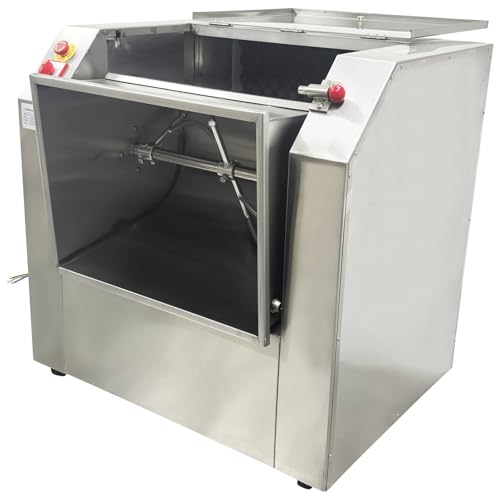
- 100-quart, 50-kg capacity
- 3,000W all-copper motor
- Tilt head with reverse mode
Best For: High-volume restaurants and food manufacturers
Heavy-Duty Tilt-Bucket Mixer – 25KG Dough Kneading Machine
For kitchens that need a high-capacity dough kneading machine commercial setup, this TECHTONGDA mixer combines a 25 kg batch capacity with a 90-degree tilt bucket. Its 2200W motor and two-direction mixing design are suited to buns, dumplings, noodles, and meat fillings, though the manufacturer says it is not intended for bread or pizza.
Best For: Restaurants, schools, and commercial kitchens preparing large batches of buns, dumplings, noodles, or meat fillings.
Pros:
- Mixes up to 25 kg of dough in one run.
- 90-degree tilting bowl simplifies dough removal and cleaning.
- Twisted dragon-shaped mixer rotates in two directions for thorough mixing and easier unloading.
- Stainless steel food-contact components and bottom-mounted motor support stability.
Cons:
- Single-speed operation offers less control than multi-speed mixers.
- Not suitable for making bread or pizza, according to the supplied product notes.
- Its large capacity may be excessive for smaller batches.
This is a strong choice when batch size and straightforward dough handling matter more than recipe versatility. The tilt mechanism and reverse rotation are particularly useful for busy prep areas.
Versatile Commercial Stand Mixer – 20QT Lever-Lift Mixer
This VEVOR model is a practical dough kneading machine commercial buyers can use for more than dough. Its 20-quart bowl handles batches up to 3 kg, while three speeds, a timer, and interchangeable attachments support dough, fillings, batters, frosting, cream, and egg whites.
Best For: Restaurants, bakeries, pizzerias, cafes, and hotels needing one mixer for varied commercial recipes.
Pros:
- 20-quart bowl accommodates up to 3 kg or 6.6 lb per batch.
- Three speeds cover dough, fillings, and whipping tasks.
- Includes a dough hook, flat beater, and wire whisk.
- Lever-operated bowl adjustment and a 0–30 minute timer improve workflow.
Cons:
- Users must stop the machine before changing speeds.
- At 138.9 pounds, it is a substantial floor-standing unit.
- Its 3 kg stated batch limit is lower than larger 25 kg dough mixers.
Choose this mixer if flexibility is more important than maximum dough capacity. The attachment set and timer make it well suited to kitchens producing both dough and lighter preparations.
All-Stainless Pizza Mixer – 25KG Tilt-Bowl Dough Machine
For pizzerias and bakeries seeking a dough kneading machine commercial solution, this TECHTONGDA mixer offers a 25 kg kneading capacity, a 2200W all-copper motor, and a full stainless steel build. Its two-way control supports mixing pizza dough and reversing the mixer to help remove the finished dough.
Best For: Schools, bakeries, restaurants, and pizzerias producing large batches of pizza dough, bread, buns, dumplings, or noodles.
Pros:
- Handles up to 25 kg or 55.1 lb of dough at a time.
- Full food-grade stainless steel construction is durable and easier to clean.
- 90-degree tilt bucket helps with dough removal and cleanup.
- Automatic stop when the window opens adds a safety feature.
Cons:
- Only one speed is listed, limiting mixing adjustment.
- The supplied dimensions indicate a very large machine footprint.
- Its high-capacity design may not suit low-volume kitchens.
This is the more targeted option for operations that regularly make pizza and other substantial dough batches. The stainless steel construction, tilt bowl, and reverse function prioritize commercial durability and handling.
Compact Multi-Function Mixer – 15QT Timed Commercial Mixer
This 15-quart VEVOR mixer is a flexible dough kneading machine commercial buyers can use when batch sizes are moderate. It mixes up to 1.5 kg with a dough hook, flat beater, or wire whip, and adds three speeds, a 30-minute timer, and a safety shield for everyday kitchen production.
Best For: Restaurants, bakeries, pizzerias, and commercial kitchens handling smaller batches of dough, fillings, batters, and whipped mixtures.
Pros:
- 15-quart bowl supports batches up to 1.5 kg or 3.3 lb.
- Three attachments cover heavy dough, batters, vegetables, cream, and egg whites.
- Three speeds are matched to dough, fillings, and whipping tasks.
- 30-minute timer, detachable components, and a bowl safety shield support convenient operation.
Cons:
- Its 1.5 kg capacity is smaller than heavy-duty 25 kg mixers.
- Users must stop the machine before changing speeds.
- The 500W motor is intended for a smaller capacity range.
This model is a sensible fit for operations that want one versatile mixer without the capacity of an industrial dough machine. It offers useful recipe flexibility while keeping batch sizes suited to moderate production.
High-Capacity Pick – 50QT Dual-Action Commercial Dough Mixer
For bakeries, pizzerias, and other busy kitchens, this dough kneading machine commercial model combines a 50-quart bowl with a 2200W motor. Its dual-action mixing system and two-speed gearbox are designed for consistent, high-volume dough preparation.
Best For: Commercial operations that need a large-capacity mixer for frequent bread and pizza dough production.
Pros:
- Large 50-quart bowl supports larger batches.
- Food-contact components use hygienic 304 stainless steel.
- Dual-action bowl and hook movement promotes thorough mixing.
- Safety cover automatically cuts power when opened.
Cons:
- Its 30.3-by-30.3-by-35.4-inch footprint requires substantial floor space.
- With two speeds rather than continuous speed adjustment, control is relatively limited.
This is a strong fit when batch size, durability, and safety features matter most. Verify that your workspace can accommodate its large dimensions and 110V electrical requirement.
Flexible Handling Pick – 30QT Forward-Reverse Dough Mixer
This 30-quart dough kneading machine commercial model is a practical option for smaller professional kitchens. Its 1500W motor, forward-and-reverse operation, and 90-degree bowl tilt help streamline mixing, dough removal, and cleanup.
Best For: Schools, restaurants, and bakeries that want a mid-capacity mixer with convenient dough removal features.
Pros:
- 30-quart stainless-steel mixing container handles substantial batches.
- Forward and reverse rotation supports mixing and dough removal.
- 90-degree bowl tilt makes emptying and cleaning easier.
- Cast-iron supports, belts, and an oil seal are designed for durability.
Cons:
- Its listed noise level is 85 dB.
- The 201 stainless-steel gear covers are not the same material as the mixing container.
- At 109.3 pounds, relocating it may be difficult.
Choose this model if workflow flexibility is more important than maximum capacity. The reversible mixer and tilting bowl are particularly useful where staff frequently need to remove dough between batches.
Maximum-Power Pick – 50KG Tilt-Bowl Spiral Mixer
For demanding operations, this 50KG dough kneading machine commercial model uses a 3000W all-copper motor and a spiral-style mixer. The 90-degree tilt bowl, two-way rotation, and reinforced support design are aimed at high-volume dough preparation and easier handling.
Best For: Restaurants, supermarkets, and commercial kitchens processing very large dough batches.
Pros:
- Rated for up to 50 kg or 110 pounds of dough.
- 3000W motor and bottom-mounted design support powerful, stable operation.
- 90-degree tilt bowl helps with unloading and rinsing.
- Two-way mixer rotation and wide support legs improve handling and stability.
Cons:
- Its 35-inch width requires considerable floor space.
- Only one speed is listed, limiting speed flexibility.
- The 110V machine is designed for large batches, so it may be excessive for smaller operations.
This model makes the most sense when production volume is the priority. Its large capacity and powerful motor can reduce the number of batches, while the tilting bowl simplifies cleanup and dough transfer.
Best Overall – Smart 13.8-Quart Dough Mixer
If you need a versatile dough kneading machine commercial kitchens can use for sizable batches, this 13.8-quart countertop mixer combines a stainless steel bowl, spiral hook, timer, and fermentation function. Its 500W motor is rated below 60 dB, while the detachable design supports easier cleanup.
Best For: Bakeries, cafeterias, restaurants, and large households that want large-batch dough mixing with built-in proofing support.
Pros:
- Mixes up to 14.88 pounds of dough or 9.92 pounds of flour per batch.
- Automatic 100–108°F fermentation function can support more consistent proofing.
- LED touch controls offer a 5–120-minute timer and straightforward operation.
- Removable bowl and spiral hook simplify disassembly and cleaning.
Cons:
- Its 500W motor is less powerful than the larger 3,000W commercial model in this roundup.
- The countertop footprint may still be substantial for compact kitchens.
This is a strong all-around option when batch capacity, quieter operation, and fermentation controls matter as much as kneading. The one-year warranty adds practical reassurance for regular use.
Best Safety Features – 10.5-Quart Dual-Rotation Mixer
This 10.5-quart dough kneading machine commercial model uses a dual-rotation bowl-and-hook design to increase flour contact during mixing. Its 650W copper motor, 60-minute timer, security shield, and nonslip feet make it a practical fit for restaurants, bakeries, and pizzerias.
Best For: Small commercial food operations that prioritize stable mixing, shielded operation, and simple knob-based controls.
Pros:
- Dual rotation combines a 21 RPM bowl with a 129 RPM hook for thorough mixing.
- 650W copper motor can mix up to 11 pounds of dough in about 10–15 minutes.
- Security shield triggers automatic shutoff when it is not closed tightly.
- Food-contact components are made from food-grade stainless steel.
Cons:
- Its 10.5-quart capacity is smaller than the 13.8-quart countertop option.
- At 105 pounds, it is relatively heavy to reposition.
- The timer is limited to 60 minutes.
Choose this model when operational safeguards and dual-rotation mixing are more important than maximum capacity. The push-button and knob controls keep the machine relatively uncomplicated to operate.
Best for High Volume – 100-Quart Commercial Dough Mixer
For industrial-scale production, this 100-quart dough kneading machine commercial mixer is built around a 3,000W all-copper motor and a stainless steel mixing system. It handles batches up to 50 kilograms, with forward and reverse modes, a tilt-head design, and emergency-stop control for production-focused kitchens.
Best For: High-volume restaurants, commercial kitchens, and food manufacturers that need exceptionally large dough batches.
Pros:
- 100-quart capacity supports batches up to 50 kilograms or 110 pounds.
- Powerful 3,000W motor is designed for large-scale mixing.
- Twisted-dragon agitator and bidirectional operation support thorough blending and easier dough removal.
- 90° tilt-head access, emergency stop, and cover auto-shutoff improve handling and safety.
Cons:
- Its 26.7-by-35.6-by-35.2-inch footprint requires substantial floor space.
- At 100 quarts and 3000W, it is excessive for most household or low-volume use.
- The supplied specifications list only one speed.
This is the clear capacity choice for production environments, but its size and power demand call for dedicated space and appropriate electrical planning. The tilt-head bowl and reverse function help make a very large mixer more manageable during loading and unloading.
How We Picked the Best Dough Kneading Machine Commercial
We compared these 10 machines by the factors that matter most in professional kitchens: stated dough capacity, motor wattage, bowl size, mixer design, construction materials, controls, safety features, and intended workload. We also considered whether each model is better suited to countertop production, small commercial batches, or larger bakery and food-service operations.
Specifications can vary by seller and configuration, so verify the exact voltage, plug, dimensions, included accessories, and maximum dough capacity before ordering. Flour capacity and finished-dough capacity are not always the same.
Quick Comparison
| Best For | Recommended Type | What to Prioritize |
|---|---|---|
| Small bakery or café | 10.5- to 15-quart mixer | Compact footprint, timer, easy cleaning |
| Pizza shop or restaurant | 20- to 30-quart mixer | Durable bowl, reliable drive system, batch capacity |
| High-volume bakery | 50-quart or larger spiral mixer | Heavy-duty construction, motor output, service access |
| Mixed food preparation | Commercial stand mixer | Attachments, speed control, bowl lift, versatility |
Key Buying Factors for a Dough Kneading Machine Commercial Setup
Capacity and Batch Size
Choose a machine based on your typical batch, not the largest advertised number. Leave headroom for dough expansion and proper kneading. A machine that is consistently overloaded can heat up, knead unevenly, and wear out faster.
Motor Power and Mixer Design
Higher wattage can support heavier dough, but wattage alone does not determine performance. Spiral mixers are generally focused on dough production, while planetary stand mixers offer greater flexibility for batters, creams, and other preparations. Check whether the machine has multiple speeds, forward and reverse operation, or a timed cycle.
Construction, Cleaning, and Safety
Stainless steel bowls and guards are practical for frequent food-service use. Look for removable components, a protective shield, emergency-stop or safety-interlock features, and a stable base. A machine that is difficult to clean may slow down service even if its specifications look impressive.
Power, Space, and Installation
Confirm that your kitchen can support the required voltage and amperage. Larger 110V units may need a dedicated circuit, while some high-capacity models require different electrical arrangements. Measure doorways, counters, clearance around the bowl, and storage space before buying.
Who Should Buy Which Dough Kneading Machine Commercial?
Choose a compact countertop model if you run a café, home-based baking business, or small kitchen with moderate daily output. Prioritize a timer, manageable bowl size, and simple cleanup.
Choose a 20- to 30-quart mixer for restaurants, pizzerias, and bakeries producing several dough batches per day. This range usually provides a useful balance between capacity and footprint.
Choose a 50-quart or larger machine when production volume is high and dough is a daily core product. Before purchasing, confirm floor space, electrical requirements, lifting or delivery needs, and access to replacement parts.
For most buyers, the best Dough Kneading Machine Commercial choice is the smallest model that comfortably handles your busiest routine. That approach can reduce operating costs while preserving consistent results and room for growth.