Choosing the right spectrophotometer can make color matching more predictable across printers, paper stocks, monitors, and production runs. The best option depends on whether you need professional profiling, portable inspection, or repeatable shop-floor quality control.
We compared these 10 spectrophotometers for printers by measurement capability, portability, aperture options, connectivity, workflow fit, and the practical needs of print and packaging professionals.
Best 10 Spectrophotometers for Printers Picks for 2026
Professional Display & Printer Profiling

- Profiles displays, projectors, and printers
- Measures displays up to 5000 nits
- Supports major broadcast color standards
Best For: Professional print and video color workflows
Print Production Measurement

- Measures key CMYK print-process indicators
- Offers 3mm, 5mm, and 11mm apertures
- Supports mobile-app connectivity
Best For: Packaging and pressroom quality control
Complete Color Management

- Profiles printers, displays, cameras, and scanners
- Includes ColorChecker Classic Mini target
- Supports ambient-light measurement
Best For: Photography-to-print color management
Portable Print Color Checking

- Stores up to 10,000 measurements
- Offers 8mm and 11mm apertures
- Includes auto calibration and ColorExpert software
Best For: Handheld print inspection and production control
Best Print-Focused Pick

- Built for print and packaging color control
- Includes a targeting jig for control strips
- Supports Nix apps and optional workflow software
Best For: Print professionals measuring control strips
Best Lab-Style Option
GOYOJO Portable Spectrophotometer 721

- Covers a 350–1020nm wavelength range
- Provides digital photometric measurements
- Designed for broad laboratory and quality-control use
Best For: General laboratory and analytical applications
Best Handheld Storage
Grating Color Spectrophotometer
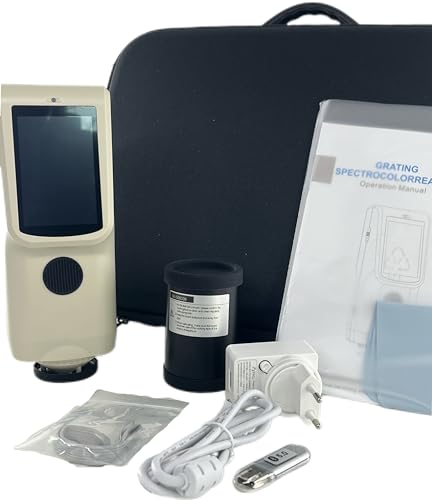
- Stores up to 10,000 samples
- Uses grating technology and a dual-32 sensor
- Includes an 8mm aperture and USB connectivity
Best For: Portable color measurement with extensive sample storage
Best Professional Pick

- 31 UV-visible channels with one scan per second
- Reports CMYK, ink density, RGB, HEX, and Delta-E
- Optional print QA software and cloud libraries
Best For: Print, packaging, and graphic-arts color professionals
Best Feature-Rich Handheld
Digital Multi-Aperture Spectrocolorimeter

- D/8 geometry with SCI and SCE modes
- Camera positioning and automatic whiteboard calibration
- Broad illuminant, color-space, and cloud-storage support
Best For: Technical color management and quality-control teams
Best App-Connected Option
Portable USB/Bluetooth Spectrophotometer
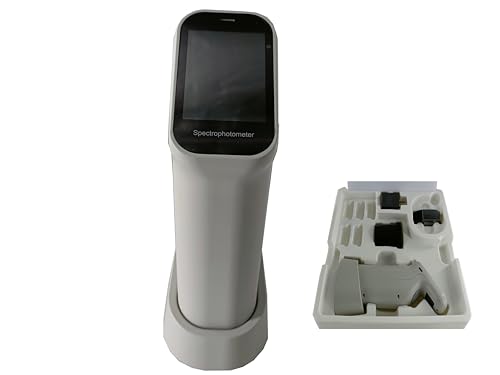
- USB and Bluetooth connectivity
- More than 30 parameters and nearly 40 light sources
- Supports mobile apps and ColorExpert PC software
Best For: Mobile print teams needing connected color management
Professional Display & Printer Profiling – i1Pro 3
The X-Rite i1Pro 3 is a professional choice among spectrophotometers for printers when your workflow also includes monitor, projector, HDR, or broadcast calibration. It combines printer quality-assurance functions with display profiling and spot-color library support.
Best For: Print and video professionals who need one instrument for printer QA, display profiling, and high-brightness HDR or broadcast workflows.
Pros:
- Supports printer profiling and quality-assurance functions.
- Measures high-luminance displays up to 5000 nits.
- Supports Rec. 709, Rec. 2020, and DCI-P3 workflows.
- Includes i1Profiler software with basic and advanced modes.
Cons:
- Its professional feature set may be more than a basic print-only workflow requires.
- The supplied notes do not specify included printer-profiling accessories.
The i1Pro 3 stands out when print consistency and display accuracy must be managed together. Its broad workflow support makes it a strong fit for demanding production environments rather than casual color checking.
Print Production Measurement – CMYK 2
This CMYK 2 digital spectrophotometer is aimed directly at packaging and printing tasks. It combines color-density and print-process measurements with selectable apertures and mobile-app connectivity, making it a practical option among spectrophotometers for printers.
Best For: Packaging, pressroom, and print-quality workflows that need density, dot-area, overprint, contrast, and spot-color measurements.
Pros:
- Provides printing-specific indicators such as density, dot area, overprint, and contrast.
- Offers 3mm, 5mm, and 11mm apertures for different sample sizes.
- Reports spectral reflectance, Lab, LCh, Delta E, whiteness, yellowness, and other measurements.
- Connects with Android, Apple, and Hongmeng mobile apps.
Cons:
- The supplied notes do not identify included software beyond mobile-app support.
- Its specialized measurement options may require training for new users.
With physical positioning guidance and a broad set of print indicators, the CMYK 2 is designed for process control rather than occasional color inspection. Its flexible apertures are useful when materials and sample sizes vary.
Complete Color Management – ColorChecker Studio
The Calibrite ColorChecker Studio is a versatile option for photographers and print professionals who need more than printer measurement. As one of the broader spectrophotometers for printers, it supports monitor, projector, printer, scanner, and camera profiling in a single workflow.
Best For: Photography and studio workflows that need consistent color from camera capture through editing, proofing, and printed output.
Pros:
- Profiles monitors, projectors, printers, paper, cameras, and scanners.
- Includes Calibrite PROFILER software for color-management workflows.
- Uses adaptive iterative profiling for display calibration.
- Includes a ColorChecker Classic Mini for custom camera profiling.
Cons:
- Its all-in-one feature set may be unnecessary for users focused only on printer profiling.
- The supplied notes do not specify supported measurement apertures.
ColorChecker Studio is especially compelling when color control spans capture, display, and print. Ambient-light measurement also helps establish a more suitable display luminance for comparing screens with physical prints.
Portable Print Color Checking – D/8 Spectrocolorimeter
This portable D/8 spectrocolorimeter is built for printing environments that need handheld measurement and substantial data storage. It offers multiple apertures, more than 30 measurement parameters, and ASTM/ISO-compliant positioning for print color evaluation.
Best For: Mobile print inspection and production teams that need repeatable measurements, multiple evaluation illuminants, and onboard storage.
Pros:
- Portable handheld design includes a visual observation feature for the measured area.
- Offers 8mm and 11mm apertures for different samples.
- Stores up to 10,000 data records.
- Uses dual optical paths and includes automatic calibration.
Cons:
- The supplied notes do not list specific connectivity options.
- At 11.02 pounds as listed, it may be less convenient for frequent travel than the word portable suggests.
The D/8 model is a practical fit when repeatability and data capacity matter in a print-quality workflow. Its calibration base, zirconium reference, and ColorExpert PC system add useful support for ongoing measurement consistency.
Best Print-Focused Pick – Nix Spectro 2 (2mm)
For professionals comparing spectrophotometers for printers, the Nix Spectro 2 (2mm) is purpose-built for print and packaging color measurement. Its targeting jig positions the device over a control strip, while compatibility with Nix Print Pro can help connect measurements to a print workflow.
Best For: Print professionals performing color measurement and print quality control on control strips.
Pros:
- Designed specifically for the print industry with a 2mm measurement format.
- Includes a targeting jig, ceramic tile, case, USB-C cable, pouch, and lanyard.
- Works with the free Nix Toolkit app and can integrate with Nix Print Pro software.
- Offers access to Pantone, RAL, and NCS libraries through a premium subscription.
Cons:
- Requires the included targeting jig to function.
- Nix Print Pro software is sold separately.
- The 2mm version is recommended only for color professionals in the print industry.
The Nix Spectro 2 is the most directly aligned option here for print-specific color control, particularly when repeatable targeting of narrow control strips matters. Its workflow integrations add flexibility, but buyers should account for the separate software and subscription options.
Best Lab-Style Option – GOYOJO Portable Spectrophotometer 721
Among spectrophotometers for printers, the GOYOJO 721 is a broader laboratory instrument rather than a print-specific handheld color tool. It provides a digital display, a 350–1020nm range, and photometric functions suited to analytical and quality-control work.
Best For: Users needing a compact visible spectrophotometer for laboratory, analytical, or general quality-control applications.
Pros:
- Measures across a 350–1020nm wavelength range.
- Specified photometric accuracy of ±1%T and repeatability of 0.5%T.
- Offers a 0–200%T and -0.3A to 3A photometric range.
- Compact construction and digital controls are intended to simplify operation and storage.
Cons:
- It is described for laboratory, clinical, food, pharmaceutical, and water-analysis uses rather than printer-specific workflows.
- At 17.11 pounds, it is less convenient for handheld or on-press use.
- The supplied listing specifies 110V operation.
The GOYOJO 721 may suit a print environment that also needs general laboratory analysis, but it is not the most targeted choice for routine press-side color matching. Its stated accuracy and broad photometric range are stronger reasons to consider it than print-focused workflow features.
Best Handheld Storage – Grating Color Spectrophotometer
For buyers seeking spectrophotometers for printers, this handheld grating spectrophotometer emphasizes portable color measurement, an 8mm aperture, and onboard storage for up to 10,000 samples. Its grating technology and dual-32 silicon photodiode array are designed to support consistent spectral readings.
Best For: Users who want a handheld color spectrophotometer with substantial sample storage and USB connectivity.
Pros:
- Uses grating spectrophotometric technology for higher-resolution color measurement.
- Features a full-band balanced LED source and dual-32 silicon photodiode array sensor.
- Stores up to 10,000 samples and includes USB connectivity.
- Provides an 8mm aperture with stated repeatability of 0.04 and interstage variation of 0.35.
Cons:
- The supplied notes do not identify dedicated printer software or print-specific targeting accessories.
- The 8mm aperture may not suit every small print control area.
- Its listed package weight is 11.02 pounds, which may be more than expected for a handheld device once packaged.
This model is an appealing middle ground for color measurement when portability and large sample capacity matter. However, buyers who need a clearly print-specific workflow should verify software, calibration, and target compatibility before choosing it.
Best Professional Pick – Nix Spectro 2
The Nix Spectro 2 is a strong choice among spectrophotometers for printers who need portable color measurement with print-focused metrics. It scans once per second across 31 UV-visible channels and reports CMYK, ink density, RGB, HEX, and Delta-E data through the Nix Toolkit app.
Best For: Print, packaging, and graphic-arts professionals who need portable color QA and consistent press output.
Pros:
- Provides print-relevant CMYK, ink-density, and Delta-E readings.
- Portable design offers capabilities comparable to a benchtop machine.
- Works with the Nix Toolkit app and supports customizable cloud color libraries.
- Optional Nix Print Pro software adds enhanced color QA features.
Cons:
- Enhanced Pantone, RAL, and NCS compatibility requires a subscription.
- Nix Print Pro software is available separately.
Choose the Spectro 2 when print consistency and a familiar mobile workflow matter more than having every feature included at the base price. Its dedicated print metrics make it especially practical for color control at the press.
Best Feature-Rich Handheld – Digital Multi-Aperture Spectrocolorimeter
This handheld spectrocolorimeter suits printers and production teams seeking broad measurement flexibility. Its D/8 optical structure, SCI/SCE modes, camera positioning, automatic whiteboard calibration, and extensive color-space and illuminant support are designed for repeatable color management and quality control.
Best For: Technical color teams that need multiple apertures, measurement standards, illuminants, and cloud-based database access.
Pros:
- Supports D/8 geometry with SCI and SCE measurement modes.
- Full-waveband 400–700 nm LED lighting plus UV supports fluorescent-material measurements.
- Automatic whiteboard calibration and a built-in camera help improve positioning and repeatability.
- Offers multiple color spaces, illuminants, cloud storage, and a calibration certificate.
Cons:
- The extensive settings and measurement options may be more than a basic print workflow needs.
- The supplied information does not specify the included software’s complete feature set.
This is the most standards-oriented option of the three, making it appealing when measurement control and documentation are priorities. It is better suited to technical environments than to simple spot-checking.
Best App-Connected Option – Portable USB/Bluetooth Spectrophotometer
This portable spectrophotometer is a practical fit for printers who want wireless connectivity and straightforward access to color-management tools. It combines USB and Bluetooth ports with a silicon photodiode array, double 16-group full-band equalization LED lighting, and repeatability rated at ΔE*ab≤0.03.
Best For: Mobile print teams that want app access, cloud-connected workflows, and more than 30 measurement parameters.
Pros:
- Supports USB and Bluetooth connectivity for flexible operation.
- Offers more than 30 measurement parameters and nearly 40 evaluation light sources.
- Works with Android, Apple, Hongmeng, and WeChat mini-program tools.
- Includes the PC-based ColorExpert color-management system.
Cons:
- Its stated repeatability of ΔE*ab≤0.03 is slightly less precise than the ΔE*ab≤0.02 claim of the other handheld model.
- The supplied details do not describe specific CMYK, ink-density, or Delta-E reporting workflows.
Consider this model when connectivity and software compatibility are central to your workflow. It offers a broad parameter set and useful mobile support, while the included ColorExpert system adds a desktop option for more structured color management.
How We Picked the Best Spectrophotometers for Printers
We focused on the features that have the greatest effect on real-world color measurement: stated accuracy and repeatability, supported measurement geometries, aperture size, calibration requirements, software compatibility, data storage, and connection options. We also considered whether each device is better suited to printer profiling, press-side verification, packaging inspection, laboratory analysis, or general color management.
Because product specifications and software support can vary by seller and configuration, confirm the manufacturer’s current documentation before purchase. A device with excellent specifications is only useful if it integrates with your profiling software and production workflow.
Quick Comparison
| Best For | Look For | Most Useful Features |
|---|---|---|
| Printer and monitor profiling | Color-management software support | Automated chart reading, display support, profiling tools |
| Press-side quality control | Portability and fast measurements | Built-in targeting, onboard storage, rechargeable operation |
| Packaging and small color targets | Small aperture options | 2mm or similarly narrow measurement area |
| Laboratory analysis | Wavelength range and repeatability | Visible-spectrum coverage, calibration controls, data export |
| Flexible production environments | Broad connectivity | USB, Bluetooth, or other workflow-friendly interfaces |
Key Buying Factors for Spectrophotometers for Printers
Measurement Geometry and Aperture
Geometry determines how the instrument views reflected color, while aperture size determines how large an area is measured. Larger apertures can average textured or uneven surfaces; smaller apertures are useful for narrow swatches, labels, text, and packaging details. Check whether the device supports the measurement conditions required by your standards or customers.
Accuracy, Repeatability, and Calibration
Accuracy describes how closely readings approach a reference, while repeatability describes consistency between repeated measurements. For production control, dependable repeatability is often as important as a low stated error. Look for clear calibration procedures and a supplied white reference or calibration accessory.
Software and Connectivity
Printer profiling usually requires compatible software, chart-reading support, and reliable communication with a computer. USB can provide a stable studio connection, while Bluetooth is convenient for mobile inspections. Verify operating-system support, supported profiling applications, and whether software is included or sold separately.
Portability and Data Handling
Choose a compact, battery-powered model for press checks and field work. Onboard storage is valuable when measurements must be collected away from a workstation, while direct computer access is better for immediate profiling and reporting.
Who Should Buy Which Spectrophotometers for Printers?
- Color-management professionals: Choose a complete profiling system designed to work with displays, printers, scanners, and projectors.
- Commercial print shops: Prioritize fast operation, dependable repeatability, durable construction, and software that supports press verification.
- Packaging and label specialists: Consider a small-aperture instrument when targets are narrow, detailed, glossy, or difficult to isolate.
- Mobile inspectors: Select a portable unit with onboard memory and USB or Bluetooth connectivity.
- Laboratories and technical teams: Favor broad wavelength coverage, documented standards compliance, precise repeatability, and robust export options.
Before ordering, match the instrument’s aperture, geometry, software, and connection method to your existing workflow. The right spectrophotometer is the one that produces repeatable readings under the same conditions your printer, press, substrates, and quality standards require.