Adding more illuminated case fans can quickly turn a clean PC build into a cable-management problem. The right ARGB fan controller simplifies connections while helping deliver consistent lighting and dependable fan control.
We selected 10 options covering compact splitters, magnetic hubs, remote-controlled kits, and higher-capacity controllers. Use the guide below to match capacity, connector compatibility, and control features to your build.
Best 10 Argb PC Fan Controllers Picks for 2026
Best for Expanding ARGB Connections

- Supports up to eight groups of 5V 3-pin ARGB devices
- Uses SATA power for stable output
- Adhesive and magnetic mounting options
Best For: Expanding compatible ARGB connections with tidy cable management
Best Standalone ARGB Lighting Controller
Fyntave ARGB Fan Controller Kit

- Requires no motherboard ARGB support
- Offers multiple modes and brightness controls
- Uses SATA power with long cables
Best For: Older PCs needing simple 5V 3-pin ARGB lighting control
Best for Eight-Fan PWM and ARGB Builds
Thermalright FAN and ARGB HUB X8

- Supports eight ARGB and eight PWM fans
- Enables motherboard synchronization
- SATA cable is not included
Best For: Large builds needing extensive fan and ARGB header expansion
Best Magnetic 9-Port Hub

- Connects up to nine PWM fans and 5V ARGB devices
- Magnetic mounting simplifies placement and cable routing
- SATA-powered with remote and cables included
Best For: Large full-tower RGB builds
Best High-Capacity PWM Hub
Thermalright ARGB and Fan HUB X12

- Supports up to 12 PWM fan groups
- Synchronizes 5V 3-pin ARGB lighting with compatible motherboards
- Includes remote control and compact cable-management design
Best For: Fan-heavy systems using 5V ARGB
Best Remote-Controlled ARGB Kit
5V 3-Pin SATA RGB Fan Controller
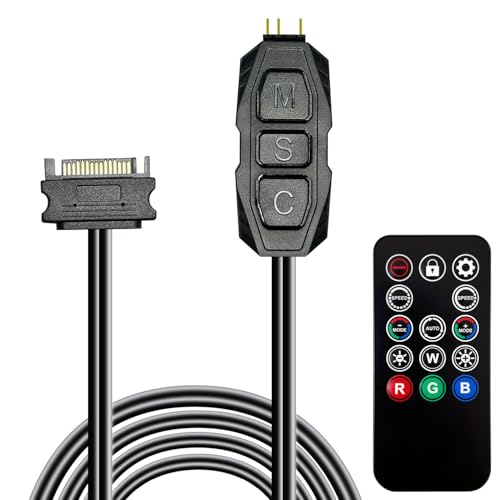
- Offers 215 dynamic modes and four static colors
- Uses simple SATA-powered, tool-free installation
- Works with compatible 5V 3-pin ARGB fans and lighting devices
Best For: Easy remote-controlled RGB upgrades
High-Capacity Remote Hub
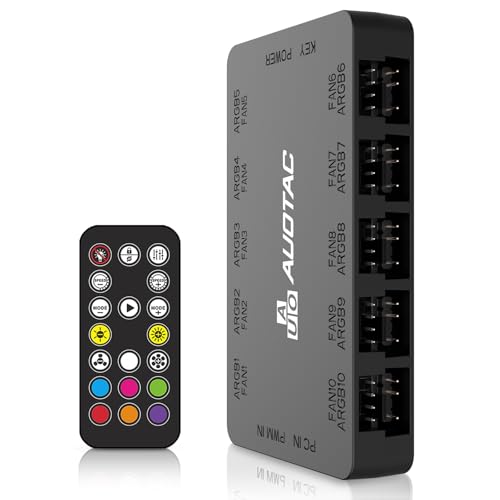
- Supports up to 10 groups of case fans
- RF remote controls fan speed and lighting
- Dual SATA inputs and magnetic mounting
Best For: Large multi-fan PC builds with remote control needs
Balanced Magnetic Hub
9-Port ARGB PWM Fan Controller

- Connects up to nine fans
- Supports synchronized 5V 3-pin ARGB lighting
- Magnetic, SATA-powered compact design
Best For: Neat desktop builds with up to nine standard fans
Standalone Lighting Control

- Powers 5V 3-pin ARGB from SATA
- Provides dozens of built-in lighting modes
- Controls speed, color, brightness, and power
Best For: Motherboard-independent ARGB lighting setups
Best for Expanding ARGB Connections – Thermalright ARGB Fan Hub
This Thermalright hub is a practical choice for builders who need more ARGB fan and lighting connections. It supports up to eight groups of 5V 3-pin ARGB devices, uses SATA power for stable output, and offers magnetic or adhesive mounting. Note that it does not support 12V 4-pin RGB devices and does not independently control fan speed or lighting effects.
Best For: PC builders expanding 5V 3-pin ARGB fan and lighting connections while keeping cables organized.
Pros:
- Supports up to eight groups of ARGB fans and compatible lighting devices.
- SATA power delivery helps maintain stable output under high load.
- Includes strong adhesive and magnetic mounting options.
- Supports PWM fan regulation and reads the speed of the fan connected to the designated red port.
Cons:
- Does not support 12V 4-pin RGB devices.
- Does not provide independent speed or lighting-effect controls.
- Only one connected fan’s speed is recognized by the motherboard.
Choose this model when connection expansion and tidy installation matter more than built-in lighting controls. Verify that your components use 5V 3-pin ARGB connectors before buying.
Best for Six-Fan Builds – ASUS TUF Gaming ARGB PWM Fan Hub
The ASUS TUF Gaming hub is designed for setups that need coordinated PWM fan and ARGB connections in one compact controller. It supports up to six case fans, includes visible power and operation indicators, and uses two SATA connectors for stable input under full load.
Best For: Gaming PCs with up to six case fans needing combined PWM and RGB connectivity.
Pros:
- Supports up to six case fans.
- Combines PWM fan and RGB connections for synchronized cooling and lighting.
- Visible indicators make power and operating status easy to check.
- Magnetic mounting simplifies attachment to a metal case surface.
Cons:
- Capacity is limited to six fans.
- Requires SATA power connections.
- Its listed dimensions may require planning for placement in smaller cases.
This is a well-matched option for a six-fan gaming build where straightforward installation and status visibility are useful. Its two SATA connectors are also suited to maintaining stable input during heavier use.
Best Standalone ARGB Lighting Controller – Fyntave ARGB Fan Controller Kit
This Fyntave controller suits older or motherboard-limited PCs because it operates directly from a SATA power connection without requiring motherboard ARGB support. It offers multiple lighting modes, color and brightness adjustments, and speed controls through its buttons for compatible 5V 3-pin ARGB fans, strips, and light plates.
Best For: Older PCs and simple builds that need standalone control of 5V 3-pin ARGB lighting.
Pros:
- Works without motherboard ARGB support.
- Provides single-color, cycle, and rainbow lighting modes.
- Offers adjustable lighting speed, color, and brightness.
- Includes a long 3-pin cable and SATA cable for flexible placement.
Cons:
- Supports 5V 3-pin ARGB products rather than 12V 4-pin RGB devices.
- Uses button controls instead of motherboard-based synchronization.
- Listed warranty coverage is 90 days from purchase.
Consider this controller when you want plug-and-play ARGB effects without adding motherboard software or compatibility requirements. Its compact body and extended cables make it convenient for straightforward installations.
Best for Eight-Fan PWM and ARGB Builds – Thermalright FAN and ARGB HUB X8
The Thermalright FAN and ARGB HUB X8 is a strong option for larger builds that need both fan-power and lighting expansion. It supports up to eight ARGB fans and eight PWM fans, allowing motherboard synchronization for 5V 3-pin ARGB effects and PWM fan speed when connected appropriately. SATA power provides direct output, but the SATA cable is not included.
Best For: Larger PC builds requiring eight PWM fan connections and eight compatible ARGB connections.
Pros:
- Supports up to eight ARGB fans and eight PWM fans simultaneously.
- Allows motherboard synchronization of ARGB lighting and PWM fan speed.
- Four lighting and fan connectors on each side help organize wiring.
- Includes strong double-sided adhesive for flexible chassis mounting.
Cons:
- SATA power cable is not included.
- Does not support 12V 4-pin RGB devices.
- Requires motherboard connections for lighting and fan synchronization.
This hub is especially useful when a motherboard lacks enough fan and ARGB headers for a heavily populated case. Confirm both connector type and SATA-cable availability before installation.
Best Magnetic 9-Port Hub – upHere P10PARGB ARGB Fan Hub
For builders who need to connect several devices, this upHere hub is one of the more flexible argb pc fan controllers. It combines nine PWM fan connections with 5V ARGB support, SATA power, magnetic mounting, and remote-based lighting control.
Best For: Full-tower builds with multiple PWM fans and 5V ARGB devices that need cleaner cable management.
Pros:
- Supports up to nine PWM fans and 5V ARGB devices in one hub.
- Magnetic mounting allows flexible placement inside the case.
- SATA-powered design provides stable power, and the kit includes the needed cables and remote.
Cons:
- Designed for 5V ARGB devices, so compatibility should be checked before connecting lighting hardware.
- Its feature set may be more than needed for a smaller build.
The P10PARGB BK is a strong choice when connection capacity and installation flexibility matter most. Its magnetic mount and included accessories make it particularly practical for larger custom RGB systems.
Best High-Capacity PWM Hub – Thermalright ARGB and Fan HUB X12
The Thermalright X12 is a compact option among argb pc fan controllers, combining 12 PWM fan connections with 3-pin 5V ARGB support. It helps consolidate fan power and lighting cables while allowing motherboard synchronization and remote lighting control.
Best For: Systems that need many PWM fan connections and synchronized 5V ARGB lighting in a compact hub.
Pros:
- Supports up to 12 groups of PWM fans and 3-pin 5V ARGB devices.
- Allows PWM speed and ARGB lighting synchronization through compatible motherboard connections.
- Compact 108 x 50 x 21 mm design includes a top ARGB accent and a light remote.
Cons:
- 12V 4-pin RGB devices are not supported.
- Only the fan connected to the red interface reports speed because of the motherboard reading limitation.
- Plastic construction may not suit buyers seeking a metal hub.
This hub is well suited to fan-heavy builds where capacity and tidy wiring are priorities. Confirm that all lighting devices use 5V 3-pin ARGB connectors before installation.
Best Remote-Controlled ARGB Kit – 5V 3-Pin SATA RGB Fan Controller
This compact kit is a straightforward pick among argb pc fan controllers for users who want remote-controlled lighting without complicated installation. It connects 5V 3-pin ARGB equipment to SATA power and offers 215 dynamic effects plus four static colors.
Best For: Simple RGB upgrades using 5V 3-pin fans, LED strips, coolers, or other compatible devices.
Pros:
- Tool-free, plug-and-use setup powered through a SATA connector.
- 14-key remote provides 215 dynamic lighting modes and four static colors.
- Compatible with several 5V 3-pin ARGB devices, including fans, strips, GPU supports, and coolers.
Cons:
- Supports 5V 3-pin ARGB equipment rather than 12V RGB hardware.
- The supplied notes do not specify a fan-count capacity.
- Remote-based control may be less convenient than motherboard software synchronization.
Choose this controller when independent lighting control and easy installation are more important than advanced motherboard integration. Its small design and SATA connection make it suitable for compact upgrades.
High-Capacity Remote Hub – 10-Fan ARGB PWM Controller
For builds with a large number of illuminated fans, this ARGB PC fan controller supports up to 10 groups of case fans while combining 5V 3-pin ARGB lighting control with 12V 4-pin PWM fan connections. Its RF remote, magnetic mounting, and dual SATA power inputs make it a practical option for centralized control.
Best For: Multi-fan PC builds that need remote lighting and PWM speed adjustment.
Pros:
- Supports up to 10 groups of ARGB case fans.
- Provides PWM speed adjustment and fan-speed reading.
- Includes RF remote control, magnetic mounting, and dual SATA power inputs.
- Offers motherboard synchronization through the included cables.
Cons:
- Uses separate 5V ARGB and 12V 4-pin PWM connections, so compatibility must be checked carefully.
- Remote-based controls may be less convenient for users who prefer motherboard software.
This is the most capacity-focused option here, with useful power and mounting features for a crowded case. It is especially suitable when ten fan groups and remote access matter more than a compact controller footprint.
Balanced Magnetic Hub – 9-Port ARGB PWM Fan Controller
This ARGB PC fan controller is designed for up to nine fans, with synchronized 5V 3-pin ARGB lighting and PWM support for standard 4-pin fans. SATA power, magnetic installation, and a compact housing help simplify installation while reducing cable clutter inside the case.
Best For: Desktop builds needing nine fan connections and a tidy magnetic hub installation.
Pros:
- Supports up to nine fans with PWM speed control.
- Synchronizes lighting for 5V 3-pin ARGB fans and LED strips.
- Magnetic backing allows repositioning without adhesive tape.
- SATA power helps prevent motherboard overload from connected fans.
Cons:
- The controller manages lighting only; PWM control requires the specified motherboard connection.
- It is not designed for 12V 4-pin RGB lighting, based on the listed 5V ARGB support.
With nine ports and a compact magnetic design, this hub offers a balanced way to expand fan connections. Confirm the motherboard and fan wiring before purchase, particularly because PWM control depends on the stated 12V 4-pin motherboard connection.
Standalone Lighting Control – Mini SATA ARGB Controller
For systems without motherboard ARGB synchronization, this compact ARGB PC fan controller powers 5V 3-pin ARGB products directly from a SATA connection. It includes built-in lighting modes and button controls for color, speed, brightness, and on/off operation without relying on motherboard software.
Best For: PCs that need standalone 5V 3-pin ARGB lighting control without motherboard support.
Pros:
- Runs directly from a power supply SATA interface.
- Includes dozens of built-in lighting modes, including monochrome and rainbow effects.
- Offers controls for mode, speed, color, brightness, and power.
- Compact design includes an extension cable and a protective connector cover.
Cons:
- Does not support motherboard software or lighting synchronization.
- Supports 5V 3-pin ARGB products rather than listed 12V RGB devices.
- Its controls are built into the controller, not provided through an RF remote.
This is a straightforward choice for adding lighting effects to a motherboard that lacks 5V ARGB support. Its small size and SATA-powered operation suit simple installations, but buyers wanting software synchronization should choose a different type of controller.
How We Picked the Best Argb PC Fan Controllers
We compared these Argb PC Fan Controllers by the details that matter during installation and everyday use: supported fan count, connector standards, power delivery, mounting options, control methods, and compatibility with common PC lighting ecosystems. We also considered whether each hub supports both PWM fan control and 5V 3-pin addressable RGB, since those functions are often confused but are not interchangeable.
Because specifications vary between models and revisions, verify the product listing and your motherboard manual before buying. A controller that accepts multiple fans may still require separate headers, SATA power, or a compatible signal connection for full control.
Quick Comparison
| Controller type | Best for | What to check |
|---|---|---|
| Compact splitter or mini hub | Small builds and limited fan expansion | Port count and SATA power requirements |
| Magnetic multi-port hub | Clean cable routing and several case fans | Mounting clearance and total connected load |
| Remote-controlled hub | Systems without convenient motherboard lighting control | Remote range, receiver placement, and mode selection |
| High-capacity hub | Large cases and many synchronized fans | Fan header type, PWM signal behavior, and power input |
Key Buying Factors for Argb PC Fan Controllers
Connector Compatibility
Confirm that your fans use 5V 3-pin ARGB connectors for addressable lighting and 4-pin PWM connectors for speed control. A 12V 4-pin RGB header is a different standard; connecting ARGB hardware to it can damage the LEDs. Some hubs support both ARGB and PWM, while others handle lighting only.
Capacity and Power
Choose a port count that covers your current fans plus likely upgrades. SATA-powered hubs reduce the electrical load on the motherboard header, but the hub still needs a motherboard signal or another control method if you want software synchronization. Check the combined fan and LED power requirements before filling every port.
Control Method
Motherboard synchronization is useful for managing lighting through software, while an included remote can be more convenient for a simple standalone setup. If fan speed matters, look for PWM pass-through or a dedicated PWM input rather than assuming an RGB controller also regulates cooling.
Installation and Cable Management
Magnetic backing makes hubs easier to position behind a motherboard tray or inside a case. Look at cable length, connector orientation, adhesive quality, and available clearance. A compact hub may be easier to hide, while a larger model can provide better access to numerous fan leads.
Who Should Buy Which Argb PC Fan Controllers?
- Small or budget builds: Choose a compact controller kit if you only need a few additional connections and basic lighting control.
- Most gaming PCs: A SATA-powered magnetic hub with both 5V 3-pin ARGB and 4-pin PWM support offers the best balance of expansion and organization.
- Large cases: Select a high-capacity eight-, nine-, or twelve-port hub, but confirm that its signal and power limits suit your complete fan layout.
- Simple, software-free setups: Pick a remote-controlled model if you want to change lighting without opening a motherboard utility.
- Quiet-focused builds: Prioritize genuine PWM support and motherboard speed control; lighting features should be secondary to reliable fan regulation.
Before installation, shut down the PC, identify every connector, connect SATA power where required, and verify the 5V ARGB polarity. Then test one fan and one lighting connection before routing the remaining cables.