The right doughnut maker can help a café, market stall, bakery, or catering business produce consistent batches without committing to a full production line. The models in this roundup range from compact countertop units to automatic machines built for higher-volume service.
Use the guide below to match capacity, controls, cleanup requirements, and available counter space to your daily demand.
Best 10 Doughnut Makers for Small Businesses Picks for 2026
Best Flexible-Output Commercial Pick
VEVOR Single-Row Automatic Donut Machine

- Up to 90 doughnuts per hour
- Three sizes with adjustable thickness
- Automatic flipping and stainless steel build
Best For: Small cafés, bakeries, and food stands needing varied doughnut sizes
Best Compact Batch Maker
Baker's Friend Mini Donut Maker

- Makes 12 mini doughnuts per batch
- Compact countertop design
- PFOA-free nonstick cooking surfaces
Best For: Low-volume sellers and home-based doughnut businesses
Best High-Volume Commercial Pick
VEVOR Six-Row Automatic Donut Machine

- Produces around 360 doughnuts per hour
- Six-row automated production
- 304 stainless steel construction
Best For: Busy operations focused on consistent ring-doughnut output
Best Smallest-Footprint Option

- Makes seven mini doughnuts per batch
- Compact 760W countertop design
- Includes recipe guide and 1-year warranty
Best For: Home-based sellers and occasional small-batch production
Best Automatic Compact Pick

- Automates the full mini-doughnut workflow
- Produces up to 250 mini doughnuts per hour
- 304 stainless steel with safety controls
Best For: Small commercial kitchens needing automated mini-doughnut production
Best Simple Batch Baker
12-Hole Commercial Doughnut Maker
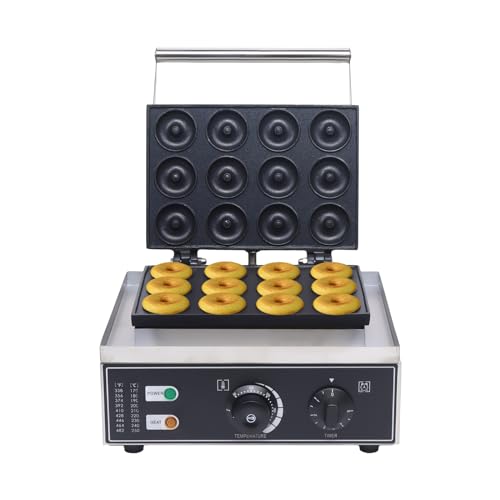
- Bakes 12 doughnuts per batch
- Double-sided 1,550W heating
- Independent temperature and timer controls
Best For: Small sellers wanting straightforward batch-baked doughnuts
Best High-Volume Flexible Pick

- Stated output of 450–800 pieces per hour
- Three molds support multiple doughnut sizes
- Automatic counting, flipping, and collection
Best For: Commercial kitchens needing high output and size flexibility
High-Output Pick
Commercial Single Row Mini Donut Maker

- Produces approximately 450–800 donuts per hour
- Automated counting, flipping, and collection
- Three mold tools for multiple donut sizes
Best For: High-volume bakeries, cafés, and dessert shops
Compact Commercial Pick

- Makes four 3.35-inch donuts in about three minutes
- Timer and temperature controls with clear scales
- Compact 11-pound countertop design
Best For: Small cafés, stalls, and moderate-volume service
Low-Volume Starter
Double-Sided Two-Hole Donut Maker

- Compact 750-watt countertop design
- Even double-sided heating with non-stick plates
- Includes oil brush and scraper
Best For: Low-volume service, breakfast counters, and small starters
Best Flexible-Output Commercial Pick – VEVOR Single-Row Automatic Donut Machine
For small businesses comparing doughnut makers for small businesses, this VEVOR model offers a useful balance of automation and format flexibility. Its 3000W power, automatic flipping, and adjustable molds are designed for cafés, bakeries, and food stands that need consistent production without constant manual handling.
Best For: Small commercial operations that want multiple doughnut sizes and up to 90 pieces per hour.
Pros:
- Produces up to 90 doughnuts per hour with a 3000W heating system.
- Automatic operation and flipping can help maintain consistent results.
- Supports mini, standard, and large doughnuts with adjustable thickness.
- 304 stainless steel construction, a 5.5L hopper, and a 14.5L oil tank suit higher-volume work.
Cons:
- Its 61.7-pound weight and larger footprint require dedicated counter or floor space.
- The commercial design may be more capacity than a very low-volume business needs.
This is a practical choice when menu flexibility matters as much as output. The three mold sizes make it easier to serve different customer preferences, while the automated frying features reduce hands-on production work.
Best Compact Batch Maker – Baker's Friend Mini Donut Maker
For a small business testing doughnut sales, catering occasionally, or adding fresh treats to a limited menu, the Baker’s Friend is a compact option among doughnut makers for small businesses. It bakes 12 mini doughnuts at a time and uses nonstick surfaces for simpler release and cleanup.
Best For: Low-volume sellers, home-based businesses, and small events focused on mini doughnuts.
Pros:
- Bakes 12 mini doughnuts in a batch within minutes.
- Compact 12-by-11-inch footprint takes up relatively little counter space.
- PFOA-free nonstick surfaces support easy cleanup and even cooking.
- Works with cake mix, brownie mix, and other batters.
Cons:
- Its mini-doughnut format and batch design are better suited to low-volume production.
- It does not provide the automated frying or larger commercial capacity of dedicated machines.
This appliance makes the most sense for businesses prioritizing low startup cost, simple operation, and a small footprint. It can support made-to-order batches, but larger-volume operations may outgrow its 12-doughnut capacity.
Best High-Volume Commercial Pick – VEVOR Six-Row Automatic Donut Machine
Businesses that need substantial throughput should consider this six-row VEVOR when evaluating doughnut makers for small businesses with busy service periods. It is designed to produce around 360 ring doughnuts per hour, with automated flipping and a control panel intended to simplify consistent production.
Best For: Busy cafés, bakeries, food stands, and other operations needing high-volume ring doughnut production.
Pros:
- Six rows support output of around 360 doughnuts per hour.
- Automatic flipping helps promote even cooking with less manual intervention.
- Produces uniform approximately 50 mm ring doughnuts with 25 mm thickness.
- 304 stainless steel construction includes a 4.5L hopper and 9.1L oil tank.
Cons:
- It makes a fixed ring-doughnut format rather than offering multiple mold sizes.
- The 22-by-19.5-by-15-inch footprint and 41.2-pound weight require suitable workspace.
- Its high output may be unnecessary for businesses with modest demand.
This model is the strongest fit when speed and consistency take priority over product variety. Its fixed format can streamline production, while the six-row layout helps reduce bottlenecks during busy periods.
Best Smallest-Footprint Option – Dash Mini Donut Maker
The Dash Mini Donut Maker is a practical entry-level option for businesses making occasional mini doughnuts, especially from a home kitchen or compact prep area. Among doughnut makers for small businesses, its 7-doughnut capacity, 760W power, and small footprint favor simple batches rather than commercial-scale production.
Best For: Home-based sellers, occasional pop-up vendors, and businesses needing small made-to-order batches.
Pros:
- Makes seven mini doughnuts in minutes.
- Compact 8.7-by-10.6-inch design uses limited counter space.
- Nonstick, PFOA-free surface supports easier cleanup.
- Includes a recipe guide, recipe database access, and a 1-year manufacturer warranty.
Cons:
- Seven doughnuts per batch limits throughput for regular commercial demand.
- It is intended for mini doughnuts and does not offer adjustable sizes or automated frying.
This is a sensible choice for testing a doughnut concept or supplementing a small menu without dedicating much workspace. For sustained sales volume, its smaller batch size will likely require frequent cycles.
Best Automatic Compact Pick – FOHERE 4-Row Mini Donut Maker
For small businesses seeking doughnut makers for small businesses, the FOHERE offers automated mini-doughnut production in a relatively compact stainless-steel unit. It forms, fries, flips, collects, counts, and outputs doughnuts, with adjustable speed and constant temperature control for more consistent batches.
Best For: Cafes, bakeries, dessert shops, and other businesses that need automated mini-doughnut production without the footprint of a larger machine.
Pros:
- Automates forming, frying, flipping, collecting, counting, and outputting.
- Four-row operation and a 3L hopper provide stated output of up to 250 mini doughnuts per hour.
- 304 stainless-steel construction is corrosion-resistant and designed for easier cleaning.
- Includes overheating protection, double-switch safety, adjustable frying speed, and temperature control.
Cons:
- It produces 40 mm mini doughnuts rather than larger traditional doughnuts.
- The machine requires oil in the tank before operation.
- Its 1,750W power requirement may need consideration when planning a commercial workspace.
The FOHERE is a practical fit when consistent mini-doughnut volume and automation matter more than product-size flexibility. Its compact dimensions and integrated controls make it an appealing option for smaller commercial kitchens.
Best Simple Batch Baker – 12-Hole Commercial Doughnut Maker
Among doughnut makers for small businesses, this 12-hole model is a straightforward choice for batch baking rather than automated frying. Its double-sided 1,550W heating system, independent temperature and timer knobs, and non-stick cooking surface are suited to businesses that want hands-on control over doughnut production.
Best For: Restaurants, home-based sellers, and small food businesses making baked doughnuts in repeated 12-piece batches.
Pros:
- The 12-compartment pan allows multiple doughnuts to be made at once.
- Double-sided heating is designed for more even cooking, with batches taking about 1–5 minutes according to the supplied notes.
- Separate temperature and time controls make operation relatively simple.
- Stainless steel and aluminum construction combines durability with thermal conductivity.
Cons:
- It is a baking machine, not an automatic forming, frying, flipping, or counting system.
- Manual loading and unloading may limit throughput compared with fully automatic commercial models.
- The supplied notes do not specify the individual doughnut size or a maximum hourly output.
This model makes sense for operators who value a compact, uncomplicated appliance and can manage the workflow manually. It is especially suitable for varied baked doughnut flavors, but less suited to high-volume automated production.
Best High-Volume Flexible Pick – Kolice Automatic Donut Maker
For established operations comparing doughnut makers for small businesses, the Kolice provides a more production-oriented setup with automatic forming, frying, flipping, collecting, counting, and output. Its 7L hopper, 15L oil tank, three included molds, and stated capacity of 450–800 pieces per hour support multiple doughnut sizes and higher-volume service.
Best For: Bakeries, dessert shops, cafes, hotels, and food-service businesses that need flexible, high-output automatic doughnut production.
Pros:
- Automates the main production stages, including counting, flipping, collection, and output.
- Three molds support small, medium, and large doughnut sizes.
- Stated production capacity ranges from 450 to 800 pieces per hour.
- Includes timer control, dual temperature control, speed regulation, overheating protection, and an oil drain valve.
Cons:
- Its 41.34-inch depth and 25.6-inch height require substantial workspace.
- The 3,000W electrical load and seller recommendation for direct connection to a circuit breaker require installation planning.
- The controls default to Celsius, and the supplied notes say the temperature cannot exceed 250°C.
The Kolice offers the broadest size range and highest stated output in this lineup, but its larger footprint and electrical demands make it better suited to a dedicated commercial kitchen than a compact counter. Confirm space, power, and temperature-display preferences before buying.
High-Output Pick – Commercial Single Row Mini Donut Maker
For small businesses that need serious throughput, this commercial automatic machine is one of the more production-focused doughnut makers for small businesses. It can produce approximately 450–800 pieces per hour and includes automated handling features to reduce repetitive work.
Best For: Bakeries, cafés, dessert shops, bars, and self-service restaurants with substantial donut demand.
Pros:
- Produces approximately 450–800 donuts per hour.
- Automatic counting, flipping, collection, and adjustable output speed simplify operation.
- Three mold tools accommodate small, medium, and large donuts.
- Food-grade stainless steel construction and an oil drain hole support cleanup.
Cons:
- At 62 pounds and over 41 inches deep, it requires considerable counter or floor space.
- The 3,000-watt, 110-volt design may require planning for electrical capacity.
- Its commercial scale may be more machine than a low-volume operation needs.
This is the strongest choice here for businesses prioritizing output and automation over portability. Its larger footprint and higher power draw are trade-offs for the high production capacity and included size flexibility.
Compact Commercial Pick – 4-Hole Waffle Donut Machine
This compact electric model offers a practical middle ground for doughnut makers for small businesses. Its four-hole pan, double-sided heating, and separate timer and temperature controls are suited to stalls, cafés, snack bars, and other operations with moderate demand.
Best For: Small cafés, food stalls, snack bars, hotels, and businesses needing a compact countertop machine.
Pros:
- Makes four 3.35-inch donuts in about three minutes, with output listed up to 80 per hour.
- Independent 0–5 minute timer and 50–300°C temperature controls provide operating flexibility.
- Non-stick Teflon-coated plates are designed for quick wipe-down cleaning.
- Overflow grooves and anti-slip feet support tidier, steadier countertop use.
Cons:
- Its stated capacity is much lower than that of a fully automated production machine.
- The four-hole format limits each batch to four donuts.
- It has fewer automation features, such as no listed automatic counting or collection.
With an 11-pound body and compact dimensions, this machine is easier to fit into a small workspace than a full production unit. It is a sensible option when moderate output, adjustable baking, and simple cleanup matter most.
Low-Volume Starter – Double-Sided Two-Hole Donut Maker
For a small operation testing donuts or serving them alongside breakfast items, this two-hole model keeps the setup simple. Among doughnut makers for small businesses, it is suited to lower-volume use with double-sided heating and a non-stick cooking surface.
Best For: Family-run businesses, small breakfast services, and occasional commercial or home use.
Pros:
- Double-sided cast-aluminum heating plates are designed to heat evenly and quickly.
- Non-stick, PFOA-free surfaces help reduce sticking and simplify release.
- Compact 750-watt design is easy to place in a small workspace.
- Includes an oil brush and scraper.
Cons:
- Its two-hole layout offers limited batch capacity for busy service.
- The notes do not provide a specific per-hour production rate.
- The plates and exterior become very hot, requiring careful handling.
This is the most approachable option for modest demand and limited space, but it is not designed for rapid batch production. Consider it a starter or supplemental machine rather than the main unit for a high-volume donut menu.
How We Picked the Best Doughnut Makers for Small Businesses
We compared these machines by stated output, cooking format, temperature control, automation, footprint, and likely suitability for small commercial settings. Capacity claims are useful for planning, but real throughput can vary with batter consistency, operator workflow, doughnut size, recovery time, and loading speed.
We also separated compact electric makers from automatic frying or forming equipment. A small café may value simple operation and easy cleanup, while a bakery, food truck, or event vendor may need continuous production, automatic counting, and a larger hopper.
Quick Comparison
| Best for | Look for | Why it matters |
|---|---|---|
| Low-volume cafés | Compact footprint and nonstick plates | Uses less counter space and simplifies small batches |
| Markets and food stalls | Automatic forming, flipping, or counting | Reduces repetitive labor during busy periods |
| Higher-volume service | Multiple rows and high stated hourly output | Helps maintain demand during peak sales |
| Mixed menus | Adjustable temperature and timer controls | Supports more consistent results across recipes |
Key Buying Factors for Doughnut Makers for Small Businesses
Capacity and Production Speed
Estimate your busiest-hour demand rather than your average daily sales. Single-row and small batch machines suit made-to-order service, sampling, and occasional specials. Four- and six-row automatic machines make more sense when doughnuts are a core menu item. Leave headroom so the machine is not running continuously at its maximum claimed rate.
Heating and Temperature Control
Adjustable temperature settings help compensate for different batters, fillings, doughnut sizes, and ambient conditions. Double-sided heating can improve consistency, while a timer helps staff repeat the same cooking cycle. Confirm the machine’s temperature range and electrical requirements before ordering.
Workflow, Cleanup, and Safety
Nonstick cooking surfaces reduce release problems and can shorten cleanup, but they still require appropriate utensils and careful maintenance. For automatic units, check how batter is loaded, formed, dropped, flipped, and collected. A timer, auto-counting function, or built-in control panel can reduce labor, but more mechanisms also mean more parts to clean and maintain.
Size, Power, and Durability
Measure usable counter depth, overhead clearance, and nearby ventilation before choosing a commercial model. Stainless-steel construction is practical in busy food environments, but it does not eliminate the need for routine cleaning. Verify wattage, plug type, voltage, and whether the machine is suitable for your local electrical setup.
Who Should Buy Which Doughnut Makers for Small Businesses?
Choose a Compact Countertop Maker If…
You sell modest quantities, need occasional breakfast or dessert production, or have limited space. These units are generally easier to store and simpler for a small team to operate.
Choose a Multi-Row Automatic Machine If…
Doughnuts are a high-demand product and labor efficiency matters. Higher-capacity equipment is best for vendors and shops that can keep the hopper supplied and have enough room for safe loading and collection.
Choose an Adjustable Commercial Waffle-Style Maker If…
You want portion control and repeatable baked doughnuts without a frying workflow. This format can be a practical fit for cafés focused on lower-volume service and straightforward cleanup.