Digitizing a box of family photos takes more than choosing the scanner with the biggest resolution number. The right model balances image quality, speed, handling, software, and the formats you need to preserve.
We selected 10 strong options for different workflows, from fast batch scanning and wireless document handling to detailed flatbed scanning for enlargements, slides, and negatives.
Best 10 High Resolution Photo Scanners Picks for 2026
Best for Batch Photo Preservation

- Scans up to 36 photos per batch
- Duplex capture preserves notes on photo backs
- Wireless scanning with restoration tools
Best For: Large family photo collections and archives
Best Standalone Film Digitizer
Photo, Slide & Negative Scanner

- Digitizes slides, negatives, photos, and cards
- 5-inch screen supports easy previews
- Saves directly to an included 8GB SD card
Best For: Simple, computer-free film and photo conversion
Best for A3 Artwork and Documents

- 2400 dpi optical resolution with 48-bit color
- A3 scanning area for oversized materials
- Four-second color scans at 200 dpi
Best For: Large flat artwork, CAD drawings, and documents
Best Compact High-Resolution Flatbed

- 4800 x 4800 dpi photo and document scanning
- Slim design with one-cable USB connection
- Color restoration and dust-removal features
Best For: Detailed home photo and document scans
Professional Detail
- 6400 dpi resolution for detailed scans
- 4.0 Dmax for smooth tonal range
- Dual-lens system with Digital ICE
Best For: Serious photo archiving and enlargements
Compact Everyday Scanning

- 4800 dpi optical resolution
- USB powered and weighs 3.1 pounds
- Easy Photo Fix restores faded colors
Best For: Home photo scanning and occasional documents
Best for Fast Photo Batches

- 600 dpi scanning with a high-speed feeder
- Includes three photo carrier sheets
- Wi-Fi 6, USB-C, mobile, and cloud support
Best For: Large photo collections and mixed photo-document scanning
Best for Film and Large Enlargements

- Up to 6400 x 9600 dpi resolution
- Scans slides, negatives, medium-format film, and prints
- Includes Digital ICE and photo restoration software
Best For: Film archives, detailed prints, and large enlargements
Best Compact Photo Organizer

- 300 or 600 dpi scanning for varied photo needs
- Handles prints from 1 x 1 to panoramic 12-inch images
- Includes cleaning kit, carrier sheet, and organizing software
Best For: Home photo scanning, restoration, and digital album organization
Best for Batch Photo Preservation – Epson FastFoto FF-680W
The Epson FastFoto FF-680W is a practical choice for anyone digitizing large photo collections. It combines fast batch scanning with wireless connectivity, image-enhancement tools, and flexible resolutions for sharing, archiving, or enlarging photos.
Best For: Families and archivists scanning large collections of prints, postcards, Polaroids, and mixed-size photos.
Pros:
- Scans up to 36 photos per batch and reaches up to 1 photo per second at 300 dpi.
- Duplex scanning captures photos and handwritten notes on the back in one pass.
- Offers auto enhancement, color restoration, red-eye reduction, cropping, rotation, and de-skew.
- Supports wireless and USB connections, plus OCR for document scanning.
Cons:
- Its 10-sheet standard capacity is smaller than the maximum 36-photo batch capability.
- At 8.2 pounds, it is less convenient to move than a compact flatbed model.
For high resolution photo scanners focused on high-volume family archiving, the FF-680W stands out for speed and automation. Its 1200 dpi enlargement option and 600 dpi TIFF archiving support add flexibility beyond quick sharing.
Best Standalone Film Digitizer – Photo, Slide & Negative Scanner
This standalone photo, slide, and negative scanner is designed for straightforward digitizing without a computer. Its large screen, included SD card, and support for several film and print formats make it a convenient option for converting older media into JPEG files.
Best For: Users who want to digitize 35mm slides, 135 and 110 negatives, printed photos, and business cards without installing software.
Pros:
- Includes a 5-inch HD viewing screen for previewing and editing scans.
- Works offline with one-touch controls and saves directly to the included 8GB SD card.
- Supports 35mm slides, 135 and 110 negatives, 3R/4R/5R photos, and business cards.
- Includes holders, trays, cleaning brush, power adapter, USB cable, and a 3-year warranty.
Cons:
- Its listed 1080P resolution is lower than the maximum resolution of some flatbed high resolution photo scanners.
- It is primarily a film and photo digitizer rather than a high-volume document scanner.
The large built-in display and computer-free workflow make this model approachable for beginners. It is particularly useful when convenience and broad format support matter more than advanced flatbed scanning controls.
Best for A3 Artwork and Documents – VIISAN VF3240 A3 Scanner
The VIISAN VF3240 is a large-format flatbed scanner for users who need more room than a standard letter-size photo scanner provides. It combines an A3 scanning area with high-resolution output, a frameless design, and fast scanning at 200 dpi.
Best For: CAD drawings, blueprints, newspapers, magazines, school projects, and oversized photos or documents.
Pros:
- Provides up to 2400 x 2400 dpi optical resolution with 48-bit color depth.
- Scans A3 color documents at 200 dpi in as little as four seconds under specified conditions.
- Frameless glass supports edge-to-edge scanning of large materials.
- Compatible with Windows and macOS and includes auto-scan plus one-touch controls.
Cons:
- Full A3 scanning at 2400 dpi requires macOS with native ICA support; Windows A3 output reaches 1200 dpi through ViiScan.
- The CIS sensor is intended for flat materials and is not recommended for 3D objects or other raised media.
- USB connectivity may be less flexible than wireless models.
Among high resolution photo scanners, the VF3240 is best differentiated by its A3 format rather than compactness. It is a strong fit for oversized flat materials, though buyers should confirm their operating system and resolution requirements before purchasing.
Best Compact High-Resolution Flatbed – Canon CanoScan LiDE 400
Canon CanoScan LiDE 400 Slim Scanner, 7.7" x 14.5" x 0.4", Document & Photo Scanner, Black
Check Price On AmazonThe Canon CanoScan LiDE 400 is a slim USB flatbed scanner for detailed photos and everyday documents. Its 4800 x 4800 dpi resolution, image-enhancement features, and one-cable power and data connection make it a convenient desktop option.
Best For: Home users who want detailed letter-size photo and document scans in a compact flatbed design.
Pros:
- Offers 4800 x 4800 dpi resolution and 48-bit color depth for detailed image capture.
- Scans in as fast as eight seconds under the stated conditions.
- Includes color restoration and dust-removal enhancement tools.
- EZ buttons, auto scan mode, and searchable PDF support simplify routine use.
Cons:
- Its single-sheet capacity is better suited to individual scans than large batch projects.
- USB connectivity does not provide the wireless placement flexibility of some alternatives.
- The flatbed size is intended for standard documents and photos rather than oversized materials.
The LiDE 400 is a compelling choice for high resolution photo scanners when image detail and a slim footprint are priorities. It is less suitable for large archives, but its straightforward controls and enhancement features work well for occasional home scanning.
Professional Detail – Epson Perfection V850 Pro
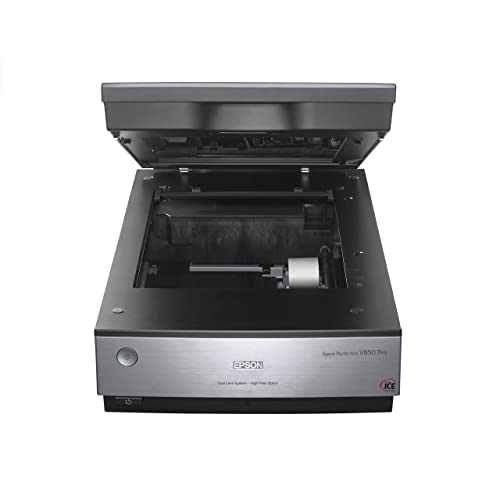
For demanding photo archiving and enlargement work, the Epson Perfection V850 Pro is a high resolution photo scanner built around a 6400 dpi dual-lens system. Its CCD sensor, 4.0 Dmax rating, and Digital ICE support are aimed at preserving fine detail, smooth tonal transitions, and shadow information.
Best For: Photographers, archivists, and serious users who want highly detailed flatbed scans.
Pros:
- 6400 dpi resolution for detailed photo scans and enlargements
- 4.0 Dmax supports smooth gradations and fine shadow detail
- Dual-lens system selects the appropriate lens for scanning needs
- Digital ICE and Windows/Mac compatibility add practical flexibility
Cons:
- Heavy 20.9-pound design takes substantial desk space
- USB connection requires a computer-based setup
- Its professional feature set may be more than casual users need
The V850 Pro is the strongest choice here when maximum scan detail and tonal performance matter more than portability or speed. Its large, professional design is best suited to a permanent scanning workspace.
Fast Photo Feeder – Canon imageFORMULA RS40
The Canon imageFORMULA RS40 is a high resolution photo scanner for users who need to process batches of old and new photos alongside everyday documents. Its automatic feeder scans both sides at once and can handle varied media, while bundled software provides photo enhancement and document tools.
Best For: Families and home offices digitizing many mixed-size photos and documents efficiently.
Pros:
- Automatic feeder scans up to 40 items per minute
- Handles photos, Polaroids, receipts, cards, IDs, and documents
- Bundled software includes red-eye correction and face smoothing
- Supports Windows and Mac, with multiple output formats
Cons:
- Its listed 1200 dpi resolution is interpolated rather than optical
- CIS design and 8-bit color depth are less specialized than a professional flatbed
- Feeder-based scanning may be less suitable for delicate or unusual originals
The RS40 prioritizes convenience and throughput over maximum optical resolution. Choose it when you have a large, varied collection to digitize and want one device for both photos and documents.
Compact Everyday Scanning – Epson Perfection V19 II
The Epson Perfection V19 II is a compact high resolution photo scanner with 4800 dpi optical resolution for photos, artwork, books, and documents. USB power, one-touch buttons, Easy Photo Fix, and a removable lid make it a convenient choice for home scanning without a large desktop footprint.
Best For: Home users who want detailed photo scans, simple controls, and a lightweight flatbed.
Pros:
- 4800 dpi optical resolution supports photo enlargements
- Easy Photo Fix can restore color to faded photos
- Lightweight 3.1-pound design is USB powered and portable
- Removable high-rise lid accommodates books and photo albums
Cons:
- Single-page flatbed design is slower for large batches
- USB connection requires a computer
- Its 1-sheet standard capacity is not suited to high-volume scanning
The V19 II offers a practical balance of resolution, simplicity, and size. It is a particularly sensible option for occasional photo restoration, artwork scanning, and everyday document work.
Best for Fast Photo Batches – ScanSnap iX2500 Photo Edition
If you need high resolution photo scanners for quickly digitizing a large collection of prints, the ScanSnap iX2500 Photo Edition combines a 600 dpi resolution with a high-capacity feeder, wireless connectivity, and photo carrier sheets for delicate originals.
Best For: Households or small offices digitizing many photos while also scanning documents, receipts, and cards.
Pros:
- Scans up to 100 photos per minute, with the feeder holding up to 36 photos.
- Includes three photo carrier sheets for delicate prints.
- Offers Wi-Fi 6 and USB-C connectivity, plus cloud and mobile support.
- Automatic optimization, naming, sorting, and customizable profiles simplify organization.
Cons:
- Its 600 dpi resolution is lower than the Epson V600’s maximum resolution.
- The automatic document feeder is less suited to highly fragile originals than a flatbed design.
The iX2500 is a strong choice when speed, workflow automation, and flexible connectivity matter more than film scanning or maximum-resolution enlargements.
Best for Film and Large Enlargements – Epson Perfection V600
The Epson Perfection V600 is one of the more versatile high resolution photo scanners for archival projects, with a flatbed design, 6400 x 9600 dpi maximum resolution, and built-in support for slides, negatives, medium-format film, and prints.
Best For: Photographers and families digitizing film, slides, negatives, and prints for detailed enlargements.
Pros:
- Supports high-resolution scans up to 6400 x 9600 dpi.
- Scans four mounted 35mm slides, 12 negatives, and medium-format film up to 6 x 22 cm.
- Includes Digital ICE for dust and scratch removal, along with photo restoration software.
- ReadyScan LED technology avoids warm-up time and reduces power consumption.
Cons:
- Uses wired Hi-Speed USB 2.0 rather than wireless connectivity.
- Its flatbed workflow is slower for large batches of loose prints than an automatic feeder.
Choose the V600 if image detail, film compatibility, and restoration tools are priorities. It is especially well suited to archival work and enlargements up to 17 x 22 inches.
Best Compact Photo Organizer – AMBIR Photo Scanner Bundle
The AMBIR photo scanner bundle is a practical option among high resolution photo scanners when you want straightforward USB operation, 300 or 600 dpi scanning, and software for cleaning up and organizing a variety of print sizes.
Best For: Home users scanning everyday prints in multiple sizes and organizing them into searchable digital albums.
Pros:
- Offers 300 and 600 dpi scanning options for everyday or archival-oriented copies.
- Handles sizes from 1 x 1 inch photos to panoramic images up to 12 inches.
- Includes a protective carrier sheet and a cleaning kit with blower, cloth, and brush.
- Software provides auto-enhancement, restoration, albums, tags, favorites, and notes.
Cons:
- USB is the only listed connection type.
- Its maximum resolution is lower than the Epson V600’s maximum.
The AMBIR stands out for its compact 8.62-ounce design and memory-management features. It is a convenient fit for users who want simple scanning and organization rather than film support or high-volume feeder scanning.
How We Picked the Best High Resolution Photo Scanners
We focused on scanners that offer meaningful improvements for photo digitization, including strong optical resolution, accurate color capture, reliable feeding, useful restoration tools, and support for common photo sizes. We also considered workflow: a scanner built for hundreds of loose prints should be judged differently from a flatbed designed for slides, negatives, or delicate originals.
Resolution claims were treated as one factor rather than the deciding factor. Optical resolution, scan quality, software controls, dust removal, file-format support, and ease of organizing finished files can matter just as much in everyday use.
Quick Comparison
- Best for large photo collections: Choose a high-speed sheet-fed model with an automatic document feeder, such as the Epson FastFoto FF-680W or Canon imageFORMULA RS40.
- Best for detailed flatbed work: The Epson Perfection V850 Pro and Epson Perfection V600 are suited to users who need high optical resolution and careful handling.
- Best compact option: The Canon CanoScan LiDE 400 and Epson Perfection V19 II fit smaller desks and straightforward photo scanning workflows.
- Best for wireless convenience: The ScanSnap iX2500 Photo Edition is designed for flexible wireless or USB operation.
- Best for slides and negatives: Look for a model with dedicated film holders, transparency support, and restoration features rather than relying on print-scanning specifications alone.
Key Buying Factors for High-Resolution Photo Scanners
Optical Resolution
For ordinary prints, 300 to 600 dpi is usually sufficient for archiving and sharing. Higher optical resolution is more valuable when scanning small originals, cropping aggressively, creating large enlargements, or digitizing film. Avoid choosing based solely on an inflated interpolated resolution figure.
Flatbed Versus Automatic Feeder
Flatbed scanners are better for fragile, thick, curled, or unusually shaped originals and typically provide more control. Automatic feeders are much faster for stacks of loose prints but require careful loading and may be less suitable for damaged photographs.
Film and Restoration Support
If you have slides or negatives, confirm that the scanner includes the correct holders and transparency hardware. Dust and scratch reduction, color restoration, fading correction, and automatic cropping can save substantial editing time, although software results vary by original condition.
Speed, Connectivity, and File Handling
Check the advertised speed at the resolution you actually plan to use. Wireless connectivity can simplify household sharing, while USB is often dependable for large archive projects. Also verify supported operating systems, included software, scan-to-cloud features, and whether the scanner can save TIFF files for higher-quality editing.
Who Should Buy Which High Resolution Photo Scanners?
Choose a fast feeder scanner if your priority is digitizing hundreds or thousands of standard-size prints with minimal manual placement. Choose a premium flatbed if image detail, enlargements, film, or delicate originals matter more than throughput. Choose a compact flatbed for occasional scanning, limited desk space, and a simpler setup. Choose a specialized photo or film scanner when automatic restoration, slides, negatives, or varying photo sizes are central to the project.
Before buying, estimate the size of your archive and decide whether you need preservation-quality files or convenient copies for sharing. That decision will determine whether speed, resolution, film support, or automation deserves the largest share of your budget.