Managing ten case fans can quickly overwhelm a motherboard’s limited headers and turn cable routing into a frustrating part of any PC build. The right fan controller adds capacity, cleaner wiring, and—depending on the model—better control over speed and lighting.
These 10 options cover straightforward powered hubs, individually controlled PWM units, ARGB-capable controllers, and remote-operated designs. Before choosing, confirm your fan connectors, lighting voltage, power requirements, and preferred control method.
Best 10 PC Fan Controllers for Ten Fans Picks for 2026
Best Value 10-Fan Hub
Thermalright 10-Port PWM Controller
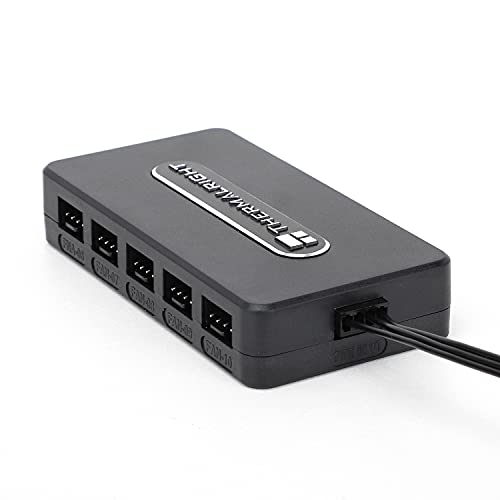
- Supports 10 four-pin fans
- SATA direct power for stable output
- Adhesive mounting and organized cabling
Best For: Straightforward high-capacity PWM fan expansion
Best for Remote Control
DARKROCK 20-Port PWM and ARGB Hub
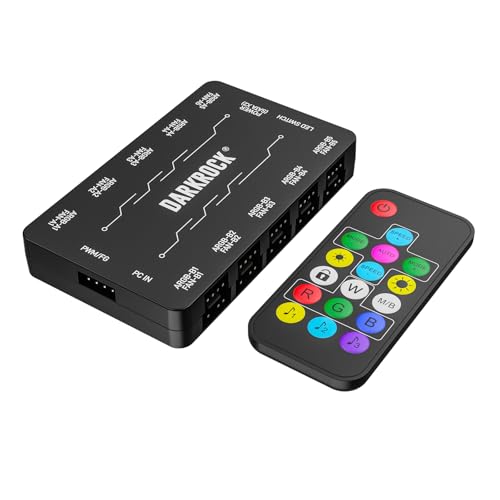
- Remote control for 10 PWM fans
- Supports 10 5V three-pin ARGB fans
- Magnetic mounting and dual SATA power
Best For: Fan and ARGB control from a remote
Best for Cable Management
Thermalright REV. A 10-Fan Hub

- Ten PWM fan connections
- Two-sided layout keeps cables neat
- SATA-powered with adhesive mounting
Best For: Organized wiring in a multi-fan desktop build
Best Safety Features

- Eight-port 5V and 12V support
- Overcurrent and short-circuit protection
- Magnetic mounting and six-year warranty
Best For: Safety-conscious builds needing up to eight fans
Best Value Expansion Hub
Ocypus Delta EH10 10-Port ARGB PWM Hub
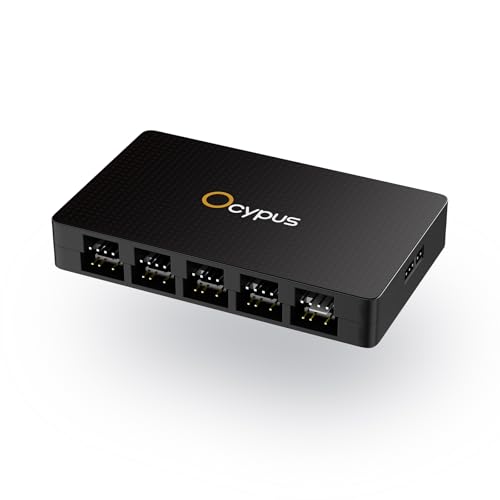
- Connects up to 10 PWM fans
- Adds 10 ports for 5V 3-pin ARGB
- SATA powered with magnetic mounting
Best For: Compact 10-fan and ARGB expansion
Best for Independent Control
ARCTIC 10-Port Individual PWM Fan Controller

- Independently controls each PWM fan
- Supports 2 A per port and 4.5 A total
- Works with Windows and Linux Kernel 7.2+
Best For: Software-managed per-fan control
Best Remote-Controlled Option
ARGB PWM 10-Fan Hub with RF Remote
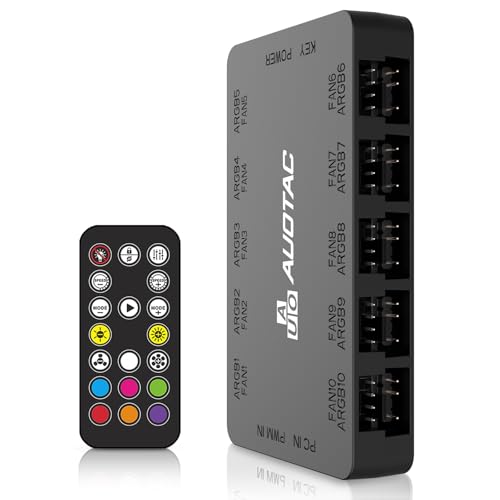
- Supports up to 10 groups of case fans
- Controls PWM speed and ARGB lighting
- Includes RF remote and dual SATA power
Best For: Remote-controlled fan and lighting setups
Best All-in-One Pick

- 10 PWM and 10 ARGB ports
- Remote, chassis, and motherboard control
- Magnetic mount with SATA power
Best For: High-device-count RGB builds
Best Simple Expansion Hub
Thermalright 8-Port ARGB Fan Hub

- Supports eight ARGB fan groups
- SATA-powered with PWM support
- Designed for tidier cable management
Best For: Eight-device ARGB expansions
Best Remote-Control Alternative

- Supports 10 ARGB PWM fans
- RF remote and chassis-key control
- Magnetic mounting with SATA input
Best For: Ten-fan builds favoring convenient lighting control
Best Value 10-Fan Hub – Thermalright 10-Port PWM Controller
If you need pc fan controllers for ten fans, this compact Thermalright hub provides 10 four-pin fan connections with SATA direct power input. It supports PWM control and keeps multiple fan cables organized, though the SATA cable must be purchased separately.
Best For: Builders who want a straightforward, space-saving hub for up to 10 PWM fans.
Pros:
- Supports up to 10 four-pin fans.
- SATA direct power helps maintain stable output under high load.
- Built-in double-sided adhesive supports simple chassis mounting.
- Reads fan speed from the fan connected to the red interface.
Cons:
- SATA power cable is not included.
- Motherboard speed reading is limited to one fan connection.
This is a practical choice when capacity and tidy wiring matter more than built-in lighting control or a remote. Its compact design makes it easy to position behind a motherboard tray or inside a case.
Best for Remote Control – DARKROCK 20-Port PWM and ARGB Hub
Among pc fan controllers for ten fans, the DARKROCK stands out by combining control for up to 10 four-pin PWM fans with connections for up to 10 five-volt three-pin ARGB fans. Its remote control and magnetic mounting add convenience, while dual SATA power inputs support stable operation.
Best For: Users who want remote fan-speed adjustment and synchronized 5V ARGB lighting.
Pros:
- Controls up to 10 PWM fans through the remote.
- Supports up to 10 five-volt three-pin ARGB fans.
- Dual SATA ports provide power from the PSU.
- Magnetic back simplifies case installation.
Cons:
- Does not support 12V RGB components.
- Requires compatible 5V three-pin ARGB connections.
This is the most feature-rich option in the group for a build with both many fans and addressable lighting. Confirm your motherboard headers and lighting voltage before buying, since 12V RGB equipment is incompatible.
Best for Cable Management – Thermalright REV. A 10-Fan Hub
This Thermalright REV. A is a useful pick among pc fan controllers for ten fans when clean routing is a priority. It offers 10 four-pin PWM connections arranged across both sides, plus SATA direct power and adhesive mounting for a tidy installation.
Best For: Desktop builders who need 10 PWM connections and neater internal fan wiring.
Pros:
- Supports 10 PWM fan connections.
- Five connectors on each side help organize cables.
- SATA direct input supports stable output under high load.
- Includes strong double-sided adhesive for mounting.
Cons:
- SATA power cable is not included.
- Only the fan on the red interface has its speed recognized.
With its two-sided connector layout, this hub is particularly suitable for cases where fan cables approach from different directions. It is a focused PWM expansion solution rather than a lighting controller.
Best Safety Features – Noctua NA-FH1 8-Port PWM Hub
The Noctua NA-FH1 is not a ten-fan controller, but it is a strong alternative if eight connections are sufficient. This magnetic PWM hub supports 5V and 12V applications, includes short-circuit and overcurrent protection, and provides up to 54W through SATA for 12V fans.
Best For: Builders prioritizing electrical protection, mixed-voltage flexibility, and a long manufacturer warranty.
Pros:
- Supports up to eight 5V or 12V fans.
- Safety fuses protect against overcurrent and short circuits.
- Provides up to 54W via SATA for 12V fans.
- Includes magnetic installation and a six-year warranty.
Cons:
- Has eight ports rather than ten.
- Full SATA power output is for 12V fans only.
Choose the NA-FH1 when safety features and component support matter more than reaching a ten-fan capacity. Its certification details, status LEDs, and warranty make it a carefully specified option for demanding desktop builds.
Best Value Expansion Hub – Ocypus Delta EH10 10-Port ARGB PWM Hub
For builders searching for pc fan controllers for ten fans, the Ocypus Delta EH10 offers a compact way to connect up to 10 PWM fans and 10 5V 3-pin ARGB devices. Its SATA power input, magnetic mounting, and port-level circuit protection make it a practical choice for a crowded case.
Best For: PC builders who need centralized 10-port PWM and 5V 3-pin ARGB expansion with a compact, magnetic hub.
Pros:
- Provides 10 PWM fan ports for synchronized speed control.
- Includes 10 ARGB output ports for compatible 5V 3-pin lighting.
- SATA powered, magnetically mountable, and equipped with individual ARGB short-circuit and overload protection.
Cons:
- Fan speed is read only from the white FAN 1 port.
- Does not support 12V 4-pin RGB connectors.
- Requires a motherboard with compatible 5V 3-pin ARGB functionality for lighting control.
The Delta EH10 is a straightforward expansion hub when your priority is fitting many PWM fans and ARGB devices into a small installation. Carefully verify the connector types before connecting it.
Best for Independent Control – ARCTIC 10-Port Individual PWM Fan Controller
Among pc fan controllers for ten fans, the ARCTIC Fan Controller stands out for independent PWM management rather than simply mirroring one motherboard signal. It supports up to 2 A per port and 4.5 A total, with native Windows and Linux Kernel 7.2+ support for compatible control and monitoring software.
Best For: Enthusiasts who want separate software-based PWM control for each fan in a multi-fan PC build.
Pros:
- Offers individual PWM control for every connected fan.
- Supports up to 2 A per port and 4.5 A total.
- Provides native driver support for Windows and Linux Kernel 7.2+.
Cons:
- Its advanced independent-control features depend on compatible software and operating-system support.
- The supplied notes do not specify ARGB lighting control.
- Power limits still need to be observed when populating all ports.
Choose the ARCTIC model if precise, per-fan adjustment matters more than lighting integration. It is particularly suited to users comfortable managing fan behavior through supported software.
Best Remote-Controlled Option – ARGB PWM 10-Fan Hub with RF Remote
This ARGB PWM hub is a flexible option for pc fan controllers for ten fans, combining support for up to 10 groups of case fans with 5V 3-pin ARGB lighting and 12V 4-pin PWM connections. Its RF remote, dual SATA power input, magnetic mounting, and protection circuitry target builders who want convenient fan and lighting control.
Best For: PC users who want remote adjustment of fan speed and ARGB lighting across a 10-group setup.
Pros:
- Supports up to 10 groups of ARGB case fans with PWM speed adjustment.
- Includes an RF remote for convenient fan-speed and lighting control.
- Uses dual SATA power inputs and includes 10-channel dual-circuit protection.
Cons:
- Lighting compatibility is limited to 5V 3-pin ARGB connections.
- The supplied notes do not specify independent control for each fan channel.
- Requires careful cable planning for the included SATA, PWM, and ARGB connections.
The HK02 is a good fit when convenience and lighting control are central to the build. Its remote and dual SATA input make it especially appealing for heavily populated cases, provided the fan and lighting connectors match.
Best All-in-One Pick – 10-Port ARGB & PWM Fan Hub
For builders comparing pc fan controllers for ten fans, this hub combines 10 PWM fan connections with 10 5V ARGB ports. SATA power, motherboard synchronization, a magnetic mount, and multiple control methods make it a flexible choice for large RGB-equipped systems.
Best For: High-device-count builds needing centralized fan and ARGB management.
Pros:
- Supports up to 10 PWM fans and 10 ARGB devices.
- Offers motherboard sync, remote control, and chassis-key control.
- Magnetic mounting supports tool-free placement inside compatible metal cases.
- SATA power helps support multi-device operation.
Cons:
- Only supports 5V 3-pin ARGB; 12V 4-pin RGB devices must not be connected.
- ARGB plug orientation must match the hub’s 5V marking.
This is the most feature-rich option of the three, particularly for RGB-heavy builds. Its combination of capacity and control options makes it a strong fit when both fan speed and lighting flexibility matter.
Best Simple Expansion Hub – Thermalright 8-Port ARGB Fan Hub
Although it is designed for eight fan groups rather than ten, this Thermalright hub is a practical alternative for users who need neater wiring and expanded 4-pin fan connectivity. SATA power and adhesive or magnetic-style mounting support straightforward installation.
Best For: Builds with up to eight ARGB fans or lighting devices that need tidy cable expansion.
Pros:
- Supports eight groups of ARGB fans and 5V 3-pin lighting devices.
- SATA power provides direct power delivery for connected devices.
- Supports PWM fan regulation and fan-speed reading from the red interface.
- Compact design and included mounting options help organize cables.
Cons:
- Does not support 12V 4-pin RGB devices.
- Only the fan connected to the red interface has its speed recognized.
- The notes state that the hub expands interfaces but does not itself control speed or lighting adjustments.
This model is better viewed as a wiring and connectivity hub than a full-featured controller. Choose it when eight-device capacity is sufficient and your motherboard will handle the actual control functions.
Best Remote-Control Alternative – J-10 10-Port ARGB Fan Hub
This 10-port hub is a useful option for shoppers seeking pc fan controllers for ten fans with convenient physical control. It supports 10 ARGB PWM fans, uses SATA power, and adds RF remote and chassis-key control for accessible lighting management.
Best For: Ten-fan RGB setups where remote or case-button control is a priority.
Pros:
- Designed to support up to 10 ARGB PWM fans.
- Includes magnetic suction mounting and SATA power input.
- Provides RF remote and chassis-key control.
- Synchronizes compatible 5V 3-pin ARGB devices.
Cons:
- 12V 4-pin RGB devices are not supported.
- ARGB plugs must be aligned with the 5V direction to avoid potential damage.
- The supplied notes provide limited detail about fan-speed adjustment beyond the controller’s stated PWM-fan support.
The J-10 stands out for accessible control and a ten-device capacity in a compact enclosure. Confirm your fans use 5V 3-pin ARGB connections before choosing it, especially if your priority is broad lighting compatibility.
How We Picked the Best PC Fan Controllers for Ten Fans
We focused on controllers and hubs that can support approximately ten fans or provide comparable multi-fan capacity. Our comparison considers connector compatibility, power delivery, PWM control, ARGB support, motherboard synchronization, mounting options, and practical cable management. We also separated simple distribution hubs from true controllers with individual adjustment, since they serve different types of builds.
Product listings can vary by revision, so verify the included cables and supported voltage before ordering. A 4-pin PWM hub is not automatically compatible with 3-pin ARGB lighting, and a lighting hub should not be treated as a fan-speed controller unless its specifications explicitly say so.
Quick Comparison
| Type | Best For | What to Check |
|---|---|---|
| Basic 10-port fan hub | Expanding one motherboard header | SATA power, PWM pass-through, connector type |
| Individual PWM controller | Separate fan-speed adjustment | Per-port current limit and software support |
| ARGB/PWM hub | Fans with lighting and speed control | 5V 3-pin ARGB versus 12V 4-pin RGB |
| Remote-control hub | Builds without convenient software control | Remote range, modes, and motherboard-sync support |
Key Buying Factors for PC Fan Controllers for Ten Fans
Connector and Lighting Compatibility
Most modern case fans use 4-pin PWM or 3-pin DC connectors for speed control. Lighting is separate: 5V 3-pin ARGB is addressable, while 12V 4-pin RGB is not interchangeable. Match the controller to the fans, and never force a lighting plug onto the wrong header.
Power Delivery and Current Limits
Ten fans can exceed a motherboard header’s safe output, especially during startup. Prefer a hub with SATA power when running many fans, and review both the total current limit and per-port rating. High-performance fans may need more power than standard low-speed case fans.
Control Method
A basic hub commonly mirrors one motherboard PWM signal across connected fans. That is useful for synchronized airflow but does not provide ten independent curves. Models with individual PWM control, operating-system support, or a remote offer more flexibility, while a simple hub is often easier to install.
Installation and Noise Management
Magnetic mounting and adhesive backing can simplify placement behind the motherboard tray, but leave enough room for SATA, PWM, and lighting cables. Group intake and exhaust fans logically, then use a gradual fan curve to reduce abrupt speed changes and unnecessary noise.
Who Should Buy Which PC Fan Controllers for Ten Fans?
- Choose a basic Thermalright-style 10-port hub if you mainly need more fan connections and synchronized motherboard control.
- Choose the ARCTIC controller if individual PWM adjustment and operating-system support matter more than the simplest installation.
- Choose Noctua’s hub if build quality, magnetic mounting, and electrical protection are priorities, and eight ports are sufficient for your layout.
- Choose an ARGB/PWM hub if your build combines ten fans with 5V 3-pin lighting and you want motherboard sync or remote control.
- Choose a remote-control model if you want quick lighting or mode changes without opening software, provided its connector and power specifications match your fans.
For most large gaming PCs, prioritize safe SATA-powered distribution, correct PWM compatibility, and a sensible mounting location before paying extra for lighting effects or remote features.