The best PWM PC fan controllers make it easier to balance cooling performance, noise, and cable management—whether you are tuning a gaming desktop, expanding a compact build, or adding temperature-based control.
This roundup covers compact manual controllers, multi-port hubs, software-managed options, and temperature-sensitive modules. Compare power limits, connector support, control methods, and installation requirements before choosing.
Best 10 Pwm PC Fan Controllers Picks for 2026
Best Manual Controller
Noctua NA-FC1 PWM Fan Controller

- Manual dial plus motherboard PWM control
- Controls up to three 4-pin fans
- No-stop mode and six-year warranty
Best For: Quieting a small group of PWM fans
Best External Power Option
12V Adjustable PC Fan Controller

- Adjusts output from 3 to 12V DC
- Supports four 3-pin or 4-pin fans
- Includes 36W AC/DC power supply
Best For: Standalone fan setups needing external adjustable power
Best High-Capacity Hub
Noctua NA-FH1 8-Port PWM Fan Hub

- Controls up to eight 5V or 12V fans
- Supports SATA power up to 54W
- Magnetic mounting and short-circuit protection
Best For: Large desktop builds with many centrally controlled fans
Temperature-Sensing Pick
ICSTATION Digital PWM Fan Controller

- Automatic or manual speed control
- Digital temperature and RPM display
- Includes a 42 cm temperature probe
Best For: Single 4-wire PWM fan setups needing temperature-based control
Multi-Fan Control Pick

- 10 ports with individual PWM control
- Up to 2 A per port and 4.5 A total
- Supports Windows and Linux Kernel 7.2+
Best For: Large PC builds requiring centralized, independent fan control
USB-Powered DIY Pick

- Type-C 5 V input with 12 V PWM output
- Includes a five-way fan splitter hub
- Supports 0–100% PWM duty-cycle adjustment
Best For: Small USB-powered systems and DIY cooling projects
Best Manual Control
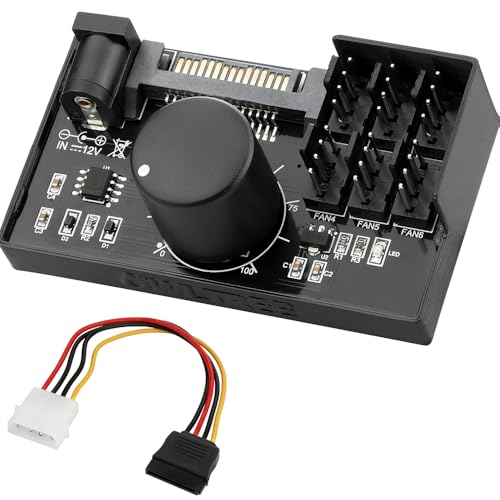
- Controls up to six 4-pin PWM fans
- SATA or DC 5525 12V input
- 1%–99% adjustable PWM duty cycle
Best For: Direct knob-based control of multiple 4-pin PWM fans
Best ARGB Expansion
Thermalright X12 Fan and ARGB Hub

- Combines 4-pin PWM and 3-pin 5V ARGB support
- Supports up to 12 connected groups
- Includes IR lighting remote
Best For: Desktop builds needing PWM fan and ARGB expansion
Best USB-C Power Option

- Type-C QC 3.0/PD 3.0 input
- Supports six 4-pin PWM fans
- 60W maximum total output
Best For: Type-C-powered setups with multiple 4-pin PWM fans
Best Manual Controller – Noctua NA-FC1 PWM Fan Controller
The Noctua NA-FC1 is a compact choice among pwm pc fan controllers when you want hands-on control over compatible 4-pin PWM fans. Its dial can reduce fan speed manually or work alongside your motherboard’s automatic PWM signal.
Best For: Quieting one to three 4-pin PWM fans while retaining flexible manual or motherboard-based control.
Pros:
- Compact controller with manual PWM-based speed adjustment.
- Can operate alongside automatic motherboard fan control.
- Includes a three-way splitter and a no-stop mode that helps prevent speeds below 300 rpm.
- Backed by a six-year manufacturer’s warranty.
Cons:
- Limited to up to three fans with the included splitter.
- Designed for 4-pin PWM fans rather than general-purpose fan control.
Choose the NA-FC1 if your priority is simple, precise fan-speed adjustment in a small package. It is especially practical for reducing noise without fully giving up automatic motherboard control.
Best RGB Fan Hub – ASUS TUF Gaming ARGB PWM Fan Hub
The ASUS TUF Gaming ARGB PWM Fan Hub suits builders who want pwm pc fan controllers with both cooling and lighting connections. It supports up to six case fans, with dual SATA power connectors intended to provide stable input under full load.
Best For: Desktop or gaming builds that need centralized PWM fan and ARGB connections for up to six fans.
Pros:
- Supports up to six case fans.
- Combines PWM fan and RGB connections for synchronized cooling and lighting.
- Uses two SATA power connectors for stable input.
- Magnetic mounting and visible power and operation indicators simplify installation and checking.
Cons:
- Requires available SATA power connections.
- Its RGB functionality may be unnecessary for builds focused only on fan-speed control.
This hub is a strong fit when fan management and lighting synchronization are both important. Magnetic mounting and status indicators also make it convenient to position and monitor inside a compatible case.
Best External Power Option – 12V Adjustable PC Fan Controller
This adjustable 12V controller takes a different approach to pwm pc fan controllers by supplying power from a 100–240V AC source and providing adjustable 3–12V DC output. It includes a four-way splitter for controlling multiple 3-pin or 4-pin fans.
Best For: Users who need an externally powered, adjustable fan setup for PCs, amplifiers, AV receivers, or gaming consoles.
Pros:
- Adjustable 3–12V DC output with up to 36W and 3A available.
- Accepts 100–240V AC input for broad voltage compatibility.
- Includes a four-way splitter for multiple 3-pin or 4-pin fans.
- Extended cable arrangement provides flexible placement.
Cons:
- Uses an external AC adapter rather than a direct motherboard-header connection.
- The supplied notes describe adjustable voltage control, not motherboard PWM signal synchronization.
Consider this model when independent power and adjustable output matter more than software-based motherboard control. Its splitter and cable lengths make it useful for flexible, standalone cooling arrangements.
Best High-Capacity Hub – Noctua NA-FH1 8-Port PWM Fan Hub
The Noctua NA-FH1 is a high-capacity option among pwm pc fan controllers, distributing a motherboard PWM signal to as many as eight connected fans. It supports 12V and 5V applications, with SATA power available for higher total output and built-in protection features.
Best For: Larger desktop builds that need centralized control, power, and monitoring for multiple 5V or 12V fans.
Pros:
- Controls, powers, and monitors up to eight fans.
- Transmits motherboard or optional NA-FC1 PWM signals to connected fans.
- Supports up to 54W through SATA for 12V fans and 24W through the 4-pin interface.
- Offers magnetic installation, status LEDs, safety fuses, and a six-year warranty.
Cons:
- SATA power is intended for 12V fans only.
- Higher-capacity operation requires careful attention to the supported power-input configuration.
The NA-FH1 is the most suitable choice here for expanding a system beyond a few fans while keeping PWM control centralized. Its magnetic mounting and short-circuit protection add practical value for complex installations.
Temperature-Sensing Pick – ICSTATION Digital PWM Fan Controller
For shoppers comparing pwm pc fan controllers, the ICSTATION module stands out for temperature-based automation and on-device monitoring. It supports 4-wire PWM fans, displays temperature and fan speed, and offers both automatic and manual control.
Best For: Users who want temperature-responsive control and RPM monitoring for a single compatible 4-wire PWM fan.
Pros:
- Automatic or manual fan-speed control.
- Digital display shows temperature and RPM.
- 42 cm temperature probe allows flexible sensor placement.
- RPM display supports readings up to 30,000 RPM in 100-RPM units.
Cons:
- Only works with 4-wire PWM fans using a 25 kHz, 5 V signal.
- Cannot control 2-wire or 3-wire fan speed.
- Working voltage must match the fan voltage.
This is a focused controller rather than a multi-fan hub, but its temperature probe and display make it useful when direct, standalone thermal management matters.
Multi-Fan Control Pick – ARCTIC 10-Port PWM Controller
Among pwm pc fan controllers, the ARCTIC Fan Controller is designed for builds with many fans and a need for individual adjustment. It provides 10 ports, separate PWM control, and support for Windows and Linux Kernel 7.2 or newer.
Best For: Multi-fan PC builds that need independent control, centralized wiring, and software compatibility across Windows or supported Linux systems.
Pros:
- Provides 10 ports with individual PWM control.
- Supports up to 2 A per port and 4.5 A total.
- Native driver support for Windows and Linux Kernel 7.2+.
- Magnetic or adhesive mounting helps with installation flexibility.
Cons:
- Its 4.5 A total limit must be considered when populating all ports.
- Individual control is most useful in larger, more complex fan setups.
Choose this model when expandability and per-fan adjustment are more important than a compact single-fan controller. It can also help reduce cable clutter by centralizing fan connections.
USB-Powered DIY Pick – 4-Pin PWM Controller and Hub
This compact option expands the flexibility of pwm pc fan controllers by accepting 5 V USB Type-C power and boosting it to a 12 V PWM fan output. The package includes a five-way splitter hub, making it suitable for small systems and DIY cooling projects.
Best For: USB-powered DIY cooling setups, routers, small hosts, and other projects using multiple compatible 4-pin PWM fans.
Pros:
- Includes a 4-pin five-way PWM fan hub.
- Uses a Type-C input and built-in 5 V-to-12 V boost circuit.
- Offers a 0–100% PWM duty-cycle adjustment range.
- Integrated power and speed control simplifies the setup.
Cons:
- Only supports 4-pin 12 V PWM fans, not 2-pin or 3-pin fans.
- Total output power depends on the connected 5 V charger.
- The charger must exceed the fans’ combined power demand for full speed.
This controller is a practical choice when wall or USB power is more convenient than motherboard power. Check the combined fan load carefully, since the adapter determines the available output capability.
Best Manual Control – 6-Fan PWM Speed Controller
This compact option is a practical choice among pwm pc fan controllers when you want direct manual speed adjustment for up to six compatible 4-pin fans. It accepts either SATA 12V or DC 5.5×2.5mm power and provides up to 60W of total output.
Best For: Users who want a simple knob-controlled controller for multiple 4-pin PWM fans.
Pros:
- Supports up to six 4-pin PWM fans.
- Offers SATA and DC 5525 12V input options.
- Provides adjustable 1%–99% PWM duty cycle.
- Supports up to 60W total output, with a 5A combined-current limit.
Cons:
- Not compatible with 3-pin or 2-pin fans.
- Fans are not included.
- Package contains the controller only.
Its physical speed knob and flexible power inputs make it straightforward for a focused fan-control setup. Confirm your fans use 4-pin PWM connectors and keep total current within the stated limit.
Best ARGB Expansion – Thermalright X12 Fan and ARGB Hub
For builds that need both fan and lighting expansion, this hub combines 4-pin PWM fan connections with 3-pin 5V ARGB support. It is a useful addition to pwm pc fan controllers when cable organization and motherboard synchronization are priorities.
Best For: Desktop users expanding PWM fan and 5V ARGB connections while keeping cables organized.
Pros:
- Supports connections for up to 12 groups of PWM fans and ARGB devices.
- Synchronizes PWM fan speed and 3-pin 5V ARGB lighting through compatible motherboard connections.
- Includes an IR light remote and a top linear ARGB design.
- Uses SATA power for direct input and has a compact 108 × 50 × 21mm body.
Cons:
- 12V 4-pin RGB devices are not supported.
- Only the fan connected to the red interface has its speed recognized by the motherboard.
- It is designed for desktop systems and requires compatible 4-pin PWM and 3-pin 5V ARGB connections.
This is more than a basic fan splitter, adding ARGB expansion and remote lighting control alongside PWM fan management. Check your lighting devices carefully, especially the distinction between 5V 3-pin ARGB and unsupported 12V 4-pin RGB.
Best USB-C Power Option – 6-Fan PWM Controller
This compact fan hub stands out among pwm pc fan controllers by accepting 12V power through Type-C with QC 3.0 or PD 3.0 support, as well as DC 5521 input. It can run up to six 4-pin PWM fans with a 60W total output limit.
Best For: Users who want Type-C-powered control for several 4-pin PWM fans.
Pros:
- Supports up to six 4-pin PWM fans.
- Accepts Type-C 12V QC 3.0/PD 3.0 and DC 5521 inputs.
- Provides up to 60W total output, with each port rated up to 2A.
- Indicator lights show PWM level and input-voltage status.
Cons:
- Not compatible with 3-pin or 2-pin fans.
- Fans and power adapters are not included.
- Combined fan current must remain within 5A.
The Type-C input makes this a flexible choice for compatible power setups, while the ten indicator lights provide a quick status reference. Verify that your Type-C charger or power source supplies the required 12V mode before connecting fans.
How We Picked the Best Pwm PC Fan Controllers
We evaluated these Pwm PC Fan Controllers by looking at the features that matter most during installation and everyday use: compatibility with 4-pin PWM fans, available ports, power delivery, control method, protection features, and mounting options. We also considered whether each unit is best suited to a single fan, a multi-fan case, a radiator, or a more specialized setup.
Not every controller serves the same purpose. Some are simple manual speed adjusters, while others distribute power to several fans or add software, temperature-probe, or ARGB control. The right choice depends on your motherboard headers, fan count, available power connectors, and desired level of automation.
Quick Comparison
| Controller type | Best for | What to check |
|---|---|---|
| Compact manual controller | One or a few fans | 4-pin compatibility and adjustment range |
| Multi-port PWM hub | Case and radiator fan expansion | Power input, per-port limits, and total wattage |
| Software-managed controller | Windows or Linux-based fan tuning | Operating-system support and internal USB connection |
| Temperature controller | Automatic cooling changes | Probe placement, display, and temperature response |
| ARGB/PWM hub | Lighting and fan consolidation | Separate ARGB and PWM standards |
Key Buying Factors for Pwm PC Fan Controllers
Fan and Connector Compatibility
Four-pin PWM fans provide the most precise speed control, but many hubs also accept three-pin DC fans with more limited regulation. Confirm the connector type and avoid assuming that a 4-pin plug always means the device supports every control feature. ARGB connectors are separate from PWM fan connectors and should not be mixed.
Power Capacity and Input
Check both the maximum current per port and the controller’s total wattage. High-performance fans, pumps, and multiple fans connected through splitters can exceed a motherboard header’s safe output. SATA, DC barrel, USB-C, or external AC-to-DC power inputs can provide additional capacity, but each has different cable and installation requirements.
Control Method
Manual knobs are convenient for quick adjustments. Motherboard-connected hubs allow BIOS or motherboard software control, while USB controllers may offer more advanced operating-system integration. Temperature-probe models can automate fan changes without relying on motherboard software, but probe placement affects accuracy.
Installation and Safety
Magnetic mounting is useful in steel cases, while adhesive or screw mounting may be better for other chassis materials. Look for short-circuit protection, clear power connections, and enough cable length for your case layout. Never force a connector or connect ARGB lighting to a fan header.
Who Should Buy Which Pwm PC Fan Controllers?
- Choose a compact manual controller if you need simple, hands-on speed adjustment for one or a few fans.
- Choose a multi-port PWM hub if your motherboard lacks enough headers or you are building a fan-heavy gaming PC.
- Choose a software-supported controller if you want centralized control and are comfortable configuring Windows or Linux tools.
- Choose a temperature controller if automatic probe-based adjustment is more important than motherboard integration.
- Choose an ARGB and PWM hub if you want to consolidate fan and lighting connections, while keeping their standards correctly separated.
Before ordering, count your fans, identify their connector types, measure the expected power draw, and confirm the controller’s input cable matches your power supply or motherboard setup.