A USB hub with individual power switches makes it easier to control connected devices without repeatedly unplugging cables. It is especially useful for peripherals, storage drives, cameras, and accessories that do not need to stay powered all the time.
We’ve selected 10 options across compact four-port models, high-capacity powered hubs, USB-C-equipped designs, and slower USB 2.0 alternatives. Use the guide below to compare port layouts, data speeds, charging support, and power requirements before choosing one.
Best 10 USB Hub with Individual Power Switches Picks for 2026
Best Compact Pick

- Four USB 3.0 ports with individual switches
- LEDs show each port’s power status
- Compact design with a 2-foot cable
Best For: Portable data connectivity with simple per-port control
Best Long-Cable Option

- Seven USB 3.0 ports for broad expansion
- 4-foot cable supports flexible placement
- Individual switches include LED indicators
Best For: Desks needing extra ports and extended cable reach
Best for Charging

- Four USB 3.0 data ports plus a smart charging port
- Individual switches with status LEDs
- Includes 5V/3A power adapter
Best For: Workstations combining data devices with USB charging
Best High-Capacity Pick

- Ten USB 3.0 ports for extensive expansion
- Individual switches and blue LED indicators
- Includes a 60W power adapter
Best For: Busy desktops with many connected USB peripherals
Best Overall
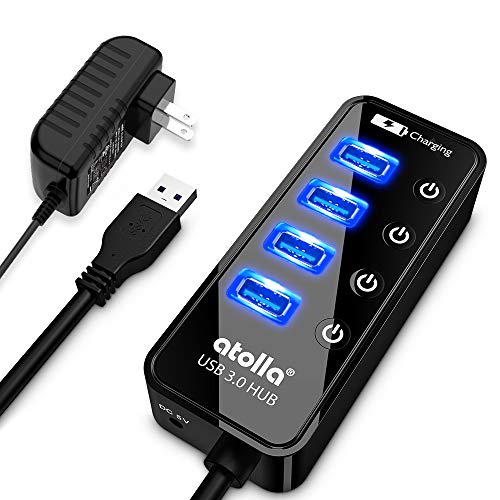
- Four illuminated individual switches
- Up to 5Gbps USB 3.0 transfers
- Includes charging port and power adapter
Best For: Everyday users who want fast, individually controlled USB ports
Best Budget Option
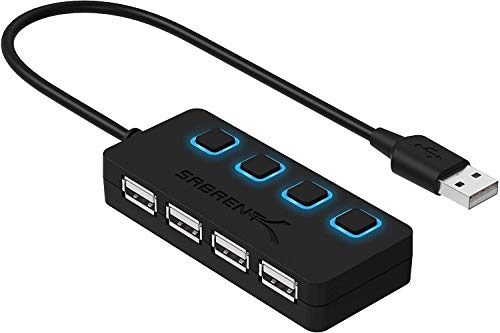
- LED-lit individual power switches
- Compact four-port design
- Plug-and-play data connectivity
Best For: Basic peripherals and users who do not need charging
Best High-Speed Pick

- Seven USB-A and USB-C ports
- Up to 10Gbps transfer speeds
- Powered aluminum hub with switches
Best For: Power users with mixed USB-A and USB-C peripherals
Best Compact 7-Port Option
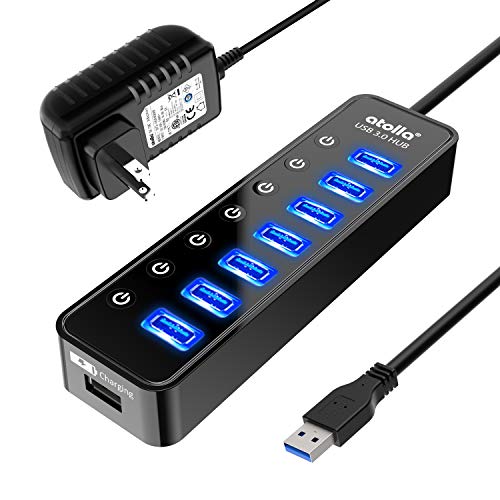
- Seven USB 3.0 data ports
- Individual on/off switches
- Dedicated charging port with adapter
Best For: Compact workstations needing controlled USB expansion
Best for Maximum Port Count

- Ten data ports plus charging port
- LED-lit individual switches
- 36W powered operation
Best For: Busy workstations with many connected peripherals
Best for Flexible Cable Placement

- Ten 5Gbps USB 3.0 data ports
- Individual LED power switches
- Long USB and power cables
Best For: Mac or PC setups needing many controlled ports
Best Compact Pick – SABRENT 4-Port USB 3.0 Hub
If you want a compact usb hub with individual power switches, the SABRENT HB-UM43 adds four USB 3.0 ports while keeping control of each connected device within reach. Its 2-foot cable provides flexible placement, and LED indicators show the power status of every port.
Best For: Laptop and desktop users who need a slim, plug-and-play hub for data peripherals.
Pros:
- Four USB 3.0 ports with transfer speeds up to 5Gbps
- Individual switches and LED power indicators
- 2-foot cable and compact 2.2-ounce design
- Works with USB 2.0 and USB 1.1 devices without drivers
Cons:
- Not intended for charging
- Provides only four total ports
The HB-UM43 is a straightforward choice when individual port control and portability matter more than maximum expansion or charging support.
Best Long-Cable Option – PANPEO 7-Port USB 3.0 Hub
The PANPEO is a practical usb hub with individual power switches for setups where extra reach and more connections are useful. It offers seven USB 3.0 ports, individual on/off controls with LEDs, and a built-in 4-foot cable for easier placement around a desk.
Best For: Home, office, school, or gaming setups that need seven ports and a longer connection cable.
Pros:
- Seven USB ports for peripherals such as drives, keyboards, printers, and controllers
- Individual on/off switches with LED indicators
- 4-foot cable helps reach distant computer or tablet ports
- Supports data speeds up to 5Gbps and older USB devices
Cons:
- Does not support charging
- Power adapter is not included
Choose the PANPEO when port count and cable length are priorities, but plan around its lack of charging support and optional power requirement.
Best for Charging – atolla 5-Port Powered USB Hub
The atolla combines a usb hub with individual power switches and dedicated power input with a smart charging port. Four USB 3.0 data ports support speeds up to 5Gbps, while the included 5V/3A adapter helps power the hub and its charging-capable port.
Best For: Users who need USB data expansion plus charging support for smartphones, tablets, and other USB-powered devices.
Pros:
- Four USB 3.0 data ports with up to 5Gbps transfer speeds
- Separate smart-charging port supplies up to 2.4 amps
- Individual switches and LEDs simplify port management
- Includes a 5V/3A power adapter and aluminum housing
Cons:
- Only four ports are intended for data connections
- Its powered design is less compact than a basic travel hub
With its included adapter and charging port, the atolla is the most versatile fit for a workstation that handles both peripherals and USB-charged devices.
Best High-Capacity Pick – SABRENT 10-Port USB 3.0 Hub
For a crowded workstation, the SABRENT HB-BU10 is a high-capacity usb hub with individual power switches that expands one USB connection into ten USB 3.0 ports. It includes a 60W power adapter, blue LED indicators, and backward compatibility for older USB peripherals.
Best For: Desktop users managing many USB devices such as hard drives, card readers, phones, and other peripherals.
Pros:
- Ten USB 3.0 ports provide substantial expansion
- Individual power switches and blue LEDs for each port
- Includes a 60W, 12V/5A power adapter
- Supports Windows, Mac, and Linux with plug-and-play setup
Cons:
- Larger than smaller four- or five-port hubs
- USB 3.0 data speeds are shared across connected devices
The HB-BU10 is the strongest choice here for users who need maximum port capacity and dedicated control across a large collection of USB equipment.
Best Overall – atolla 4-Port USB 3.0 Hub
If you want a practical usb hub with individual power switches, the atolla 4-port model combines USB 3.0 data ports with a separate charging port. Each data port can be switched on or off without unplugging connected devices, while transfer speeds reach up to 5Gbps.
Best For: Everyday laptop or desktop users who need individually controlled USB 3.0 ports and a dedicated charging port.
Pros:
- Four illuminated individual on/off switches simplify device control.
- USB 3.0 data ports support speeds up to 5Gbps.
- Includes a 5V/3A power adapter and a 65 cm cable.
- Plug-and-play compatibility with Windows, macOS, and Linux.
Cons:
- The enclosure is plastic rather than aluminum.
- The charging port is separate from the four USB 3.0 data ports.
The atolla is a well-rounded choice when individual switching matters but you still want fast file transfers and simple setup. Its four-port layout suits common peripherals such as drives, keyboards, mice, and webcams.
Best Budget Option – SABRENT 4-Port USB 2.0 Hub
The SABRENT HB-UMLS is a compact usb hub with individual power switches for basic USB expansion. Its four USB 2.0 ports include LED-lit on/off switches, making it easy to disconnect peripherals without reaching behind your computer.
Best For: Users who need affordable, individually switched ports for keyboards, mice, flash drives, and other USB devices.
Pros:
- Individual LED power switches show each port’s status.
- Compact design helps conserve desk space.
- Plug-and-play and hot-swappable with no driver installation.
- Supports daisy chaining for expansion up to 127 devices.
Cons:
- USB 2.0 limits transfer speeds to 480Mbps.
- Does not support charging.
- Provides four ports, fewer than the other options in this roundup.
This SABRENT hub is best suited to simple data connectivity rather than high-speed storage or device charging. Choose it when compact size and low-cost individual switching are more important than USB 3.0 performance.
Best High-Speed Pick – Rosonway 7-Port USB 3.2 Hub
For a high-capacity usb hub with individual power switches, the Rosonway RSH-A107C offers a mixed USB-A and USB-C layout with speeds up to 10Gbps. Its powered design includes a 12V/2A adapter, while the 3.3-foot dual USB-A/USB-C cable supports a broad range of host devices.
Best For: Power users, creators, and workstation setups that need multiple USB-A and USB-C ports with individual control.
Pros:
- Seven-port mix includes USB-A 3.2, USB-C 3.2, and USB-A 3.0 connections.
- Supports data transfer speeds up to 10Gbps.
- Individual switches include LED indicators and do not require unplugging devices.
- Aluminum housing, surge protection, and a 24W power supply add practicality.
Cons:
- The larger feature set may be more than basic users need.
- The supplied notes describe BC1.2 charging support, not a dedicated high-power laptop-charging function.
The Rosonway is the strongest fit for mixed-device desks that need both USB-A and USB-C expansion. Its powered seven-port design and fast USB 3.2 connections make it especially useful for managing several peripherals and storage devices at once.
Best Compact 7-Port Option – Atolla Powered USB 3.0 Hub
If you need a USB hub with individual power switches without taking up much desk space, the Atolla 7-port model is a practical choice. It provides seven USB 3.0 data ports, transfer speeds up to 5Gbps, and a separate smart-charging port rated up to 2.4A with the included 5V/4A adapter.
Best For: Home or office users who want individually controlled ports, fast peripheral syncing, and a more compact hub.
Pros:
- Seven USB 3.0 data ports support speeds up to 5Gbps.
- Individual on/off switches reduce the need to unplug devices.
- Dedicated charging port and included 5V/4A power adapter.
- Plug-and-play compatibility with Windows, Mac OS X, and Linux.
Cons:
- Offers fewer total ports than the 11-port alternatives.
- The enclosure is made from plastic.
- The charging port is separate from the seven data ports.
The Atolla stands out when desk space and straightforward port control matter more than maximum expansion. Its seven data ports, individual switches, and dedicated charging output cover common keyboard, mouse, printer, storage, and mobile-device needs.
Best for Maximum Port Count – JESWO 11-Port USB 3.0 Hub
The JESWO is a USB hub with individual power switches designed for setups that connect many peripherals at once. It combines 10 USB 3.0 data ports with a dedicated smart-charging port, 5Gbps transfer speeds, LED indicators, and a 36W 12V/3A power adapter.
Best For: Multitasking users, offices, and workstations that need to manage numerous USB devices from one powered hub.
Pros:
- Ten USB 3.0 data ports provide extensive expansion.
- Independent switches and LED indicators make port control easy to see.
- Dedicated charging port supports output up to 2.4A.
- Includes a 36W adapter and overheat safeguards.
Cons:
- The adapter must be connected for full functionality.
- Its larger 11-port layout may be more than a simple setup requires.
- The plastic enclosure may not suit buyers seeking a metal hub.
Choose the JESWO when the priority is capacity and visible control. The 10 data ports are useful for drives and peripherals, while the included power adapter is required to maintain full operation across the hub.
Best for Flexible Cable Placement – Wenter 11-Port USB Hub
For users comparing a USB hub with individual power switches, the Wenter offers broad expansion and straightforward device management. Its 10 USB 3.0 data ports transfer at up to 5Gbps, while a dedicated charging port can provide up to 2.4A with the included 12V/3A adapter.
Best For: Mac and PC users who need many ports, visible power status, and longer cables for flexible desk organization.
Pros:
- Ten USB 3.0 data ports support up to 5Gbps transfers.
- Individual switches and LEDs show and control each port’s power.
- Dedicated charging port supports phones, tablets, and cameras.
- Includes a 100cm USB cable and a long power cable for easier placement.
Cons:
- Full powered operation requires the included AC adapter.
- The charging output is limited to up to 2.4A per port.
- Its 11-port capacity can be excessive for basic peripheral needs.
The Wenter is a strong fit when cable reach and port visibility are important. Its 11-port design supports a crowded setup, while compatibility with USB 3.0, 2.0, 1.1, and 1.0 peripherals adds flexibility for mixed-device environments.
How We Picked the Best USB Hub with Individual Power Switches
We compared these hubs by looking at the features that matter most in daily use: the number and type of ports, USB generation, individual switch design, external power support, charging capability, cable length, status indicators, and compatibility with common computers and peripherals. We also considered whether each model is better suited to occasional desk use, a permanent workstation, or a larger collection of devices.
Individual switches are useful for cutting power to selected accessories, but they do not automatically improve data speed or charging performance. Those capabilities depend on the hub’s USB standard, power adapter, and the connected computer’s own ports.
Quick Comparison
- Best for compact setups: Four-port models from SABRENT and atolla take up less space and are easy to manage.
- Best for many peripherals: The SABRENT 10-port, JESWO 11-port, Wenter 11-port, and atolla eight-port hubs suit busy workstations.
- Best for modern high-speed devices: The Rosonway model adds USB-A and USB-C USB 3.2 ports with support for faster transfers.
- Best for basic accessories: The SABRENT USB 2.0 hub is appropriate for keyboards, mice, printers, and other low-bandwidth devices.
- Best for longer reach: The PANPEO hub includes a four-foot cable, which can help when the computer is positioned farther from the accessories.
Key Buying Factors for a USB Hub with Individual Power Switches
Port Count and Layout
Choose enough ports for your current devices plus at least one spare. Four ports work well for a keyboard, mouse, storage device, and occasional accessory. Eight to 11 ports are more practical for webcams, card readers, microphones, drives, and charging cables. Check whether the ports face forward, upward, or sideways for easier cable routing.
USB Speed
USB 3.0 is generally preferable for external storage and large file transfers, while USB 3.2 models may offer higher throughput when the computer and device support it. USB 2.0 is usually adequate for input devices and printers but can be limiting for modern storage.
Power and Charging
Powered hubs with an AC adapter are the safer choice for multiple hard drives, bus-powered devices, or accessories that draw more current. A dedicated smart-charging port may charge differently from the data ports, so check the specifications if phone or tablet charging is important.
Switches, LEDs, and Compatibility
Look for clearly labeled switches and LEDs that are easy to see without creating distracting light. Confirm compatibility with your operating system and computer ports, and remember that a hub cannot add features—such as video output or high-wattage laptop charging—that it does not explicitly support.
Who Should Buy Which USB Hub with Individual Power Switches?
Choose a four-port hub if you want simple control for a small desk setup. Pick an eight-, 10-, or 11-port powered hub if several peripherals must remain connected. Select the Rosonway USB-C model when you need a mix of USB-A and USB-C connections with faster transfer potential. For keyboards, mice, and printers, the USB 2.0 SABRENT model may be sufficient and cost-effective. If cable distance matters, the PANPEO’s longer lead can provide more placement flexibility.