PC fan controllers with temperature probes make it easier to balance cooling, noise, and temperature without constantly adjusting fan speed by hand. The models in this roundup cover compact PWM modules, digital displays, automatic temperature control, and high-temperature alarms.
Because these controllers vary in current capacity, wiring support, display features, and installation style, the right choice depends on your fans and how much control you want. Use the guide below to narrow the list before buying.
Best 10 PC Fan Controllers with Temperature Probes Picks for 2026
Best High-RPM Monitoring

- Manual and automatic speed control
- Temperature and RPM digital display
- 42cm probe; reads up to 30,000 RPM
Best For: High-RPM 4-wire PWM fan setups
Best High-Current Control

- 12V PWM control with 5A capacity
- High-temperature alarm included
- 700–800 RPM stall-alarm threshold
Best For: Higher-current 12V PWM cooling projects
Best Low-Noise Automation
KOOBOOK Digital PWM Controller

- Manual and automatic control modes
- RPM display up to 30,000 RPM
- 42cm probe for temperature-based adjustment
Best For: Compatible PC, CPU, and server fans
Best High-Capacity Board

- 5A maximum per output
- Up to 9A bus current
- PWM control with stall-alarm specification
Best For: High-capacity 12V PWM cooling builds
Best DIY Build
PWM Fan Controller Soldering Kit

- DIY PCB assembly with LCD display
- NTC probe measures 0–100°C
- Supports 2-, 3-, and 4-wire DC fans
Best For: Makers and electronics learners
Best High-Load Module

- Up to 5A per channel
- 50K B=3950 temperature probe
- Compact board with LED and stall alarm
Best For: Higher-current 12V cooling systems
Best 4-Wire Display Controller
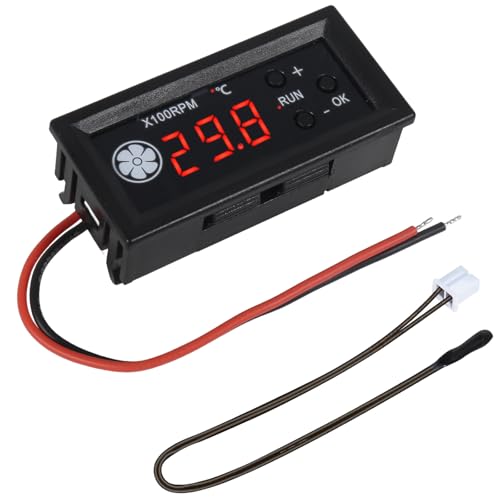
- Automatic and manual control modes
- 42 cm probe with digital temperature display
- Designed for 4-wire 25 kHz PWM fans
Best For: Modern 4-wire PWM PC cooling systems
High-Load PWM Control
12V Fan Temperature Controller

- Supports parallel 12V fans within the stated current limit
- Four temperature zones for automatic speed control
- Includes stall-warning fan monitoring support
Best For: Multi-fan 12V cooling setups
Display-Controlled Cooling
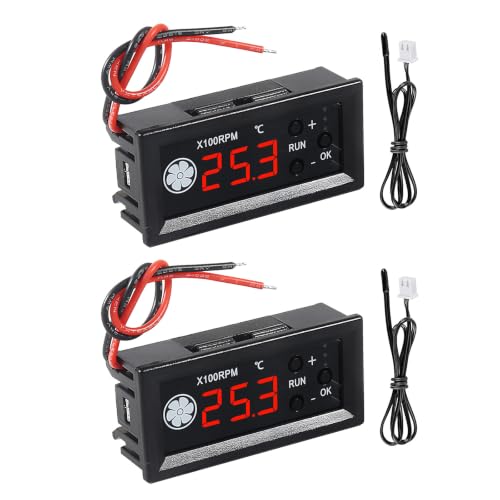
- Shows temperature and RPM on a digital display
- Offers manual and automatic control modes
- Includes a 42 cm NTC10KB temperature probe
Best For: Four-wire PWM setups needing live readings
Precision RPM Monitoring

- Automatic temperature-based fan-speed adjustment
- 100-RPM display increments up to 30,000 RPM
- Includes a 42 cm NTC10KB temperature probe
Best For: Four-wire PWM systems needing detailed RPM feedback
Best High-RPM Monitoring – ICSTATION PWM Fan Controller
For shoppers comparing pc fan controllers with temperature probes, the ICSTATION combines automatic or manual control with a digital readout. It is designed for 12V, 4-wire PWM fans and displays temperature alongside fan speed in 100-RPM increments.
Best For: Users with high-RPM 4-wire PWM fans who want visible temperature and RPM monitoring.
Pros:
- Automatic and manual fan-speed modes
- Displays temperature and RPM, with readings up to 30,000 RPM
- Includes a flexible 42cm temperature probe
Cons:
- Only works with 4-wire PWM fans using a 25KHz, 5V signal
- Fan voltage must match the controller’s working voltage
This is a practical choice when RPM visibility and broad high-speed fan readout range matter. Confirm your fan wiring and voltage before buying.
Best High-Current Control – NOYITO 5A PWM Fan Controller
The NOYITO is a 12V option among pc fan controllers with temperature probes, offering PWM fan-speed control and a high-temperature alarm. Its specifications also identify a 5A rating and a 700–800 RPM minimum stall-alarm threshold.
Best For: 12V PC cooling projects that need a higher-current PWM controller and temperature alerting.
Pros:
- Supports DC 12V operation and up to 5A
- Includes a high-temperature alarm function
- Provides a 700–800 RPM minimum stall-alarm specification
Cons:
- Temperature accuracy can vary by approximately 3–5%
- Probe uses a 50K B=3950 specification, so compatibility should be checked
The NOYITO stands out for its 5A capacity and alarm-oriented design. Review the probe and fan requirements carefully, particularly if precise temperature control is important.
Best Low-Noise Automation – KOOBOOK Digital PWM Controller
The KOOBOOK offers automated and manual adjustment for 12V, 4-wire PWM fans, making it a useful candidate among pc fan controllers with temperature probes. Its display shows temperature and RPM, while automatic adjustment can help balance cooling demand and fan noise.
Best For: PC cases, CPU fans, and compatible server fans where automatic low-noise control is useful.
Pros:
- Manual and automated fan-speed modes
- Digital RPM display in 100-RPM increments up to 30,000 RPM
- Includes a 42cm probe for continuous temperature readings
Cons:
- Designed exclusively for 4-wire PWM fans
- Cannot control 2-wire or 3-wire fan speeds
With its display and dual control modes, the KOOBOOK is well suited to users who want hands-on adjustment plus temperature-based automation. Verify that your fans use the required 25KHz, 5V PWM signal.
Best High-Capacity Board – HiLetgo 5A PWM Controller
The HiLetgo is a board-style 12V choice for shoppers seeking pc fan controllers with temperature probes and substantial current capacity. It supports up to 5A per output and a 9A bus current, alongside PWM speed control and a stall-alarm threshold.
Best For: 12V cooling builds needing high output capacity and PWM fan temperature control.
Pros:
- Maximum 5A current per output
- Bus current rated up to 9A
- Includes PWM control and a 700–800 RPM stall alarm specification
Cons:
- Requires a 12V power source
- Temperature probe uses a 50K B=3950 specification
The HiLetgo is the strongest fit here when current capacity is a priority. Its board format and probe specifications make it especially important to confirm the intended wiring and system compatibility first.
Best DIY Build – PWM Fan Controller Soldering Kit
For makers seeking PC fan controllers with temperature probes, this kit combines hands-on assembly with practical fan regulation. It supports 2-, 3-, and 4-wire DC fans, includes an LCD display, and offers button or IR-remote control.
Best For: DIY electronics projects, learning PWM fan control, and users who want temperature and RPM information on an LCD.
Pros:
- Includes a PCB, components, LCD display, temperature probe, and remote control.
- NTC sensor measures temperatures from 0–100°C and supports temperature-based adjustment.
- Works with 2-, 3-, and 4-wire DC fans and provides five speed levels.
Cons:
- Requires soldering and assembly before use.
- Designed around 12V DC fan applications.
This is the most project-oriented option in the group. Choose it if building and experimenting are part of the appeal; users wanting a ready-to-install controller may prefer a preassembled module.
Best High-Load Module – 12V 5A PWM Fan Thermostat
This compact module is a practical choice among PC fan controllers with temperature probes when higher current capacity matters. It runs on 12V DC, uses a temperature probe for thermostat control, and provides LED status information.
Best For: 12V cooling setups needing a compact PWM controller with up to 5A per channel and a buzzer-based stall alert.
Pros:
- Supports up to 5A output per channel and 9A maximum bus current.
- Includes a 50K B=3950 temperature probe.
- Compact 50 × 43 × 13 mm board with LED display and stall-alarm support.
Cons:
- Temperature probe accuracy is listed at approximately 3–5%.
- Requires a 12V DC setup and separate installation or enclosure planning.
- Minimum speed for the stall alarm is approximately 700–800 RPM.
Its current ratings make it worth considering for demanding 12V cooling systems. Verify your fan wiring, power supply, and channel requirements before installation, especially if using the alarm threshold as a safety check.
Best 4-Wire Display Controller – Automatic PWM Fan Governor
For modern 4-wire systems, this controller offers automatic temperature-based adjustment plus manual override. It includes a 42 cm temperature probe, a digital display for temperature and RPM, and PWM control designed for standard 25 kHz, 5V-signal fans.
Best For: PC, gaming, or specialized cooling setups using compatible 4-wire PWM fans and needing at-a-glance RPM and temperature readings.
Pros:
- Automatically adjusts fan speed according to temperature.
- Offers manual and automatic control modes.
- Displays temperature and RPM, with RPM shown in units of ×100.
- Includes a 42 cm probe for positioning near a CPU, GPU, or other component.
Cons:
- Only controls speed on compatible 4-wire PWM fans.
- Uses a 12V supply with a 3A controller rating.
- Probe placement and fan compatibility must be checked before installation.
This is the clearest fit for users who want automatic control without giving up manual adjustment or visible RPM feedback. It is less flexible than the DIY kit, but better suited to a ready-made 4-wire PWM setup.
High-Load PWM Control – 12V Fan Temperature Controller
For shoppers comparing pc fan controllers with temperature probes, this two-pack is built around high-current 12V fan control. It supports automatic temperature regulation, air-cooling speed control, and parallel fan operation when the combined load stays within the stated limits.
Best For: Multi-fan 12V setups that need higher current capacity and automatic temperature control.
Pros:
- Supports multiple 12V fans in parallel up to the stated 5A total-current limit.
- Provides automatic temperature control with four temperature-zone settings.
- Offers fan monitoring with three-wire stall warning support.
- Includes two controller modules.
Cons:
- Designed for internal 12V fans, so compatibility should be checked before installation.
- Actual control performance varies by fan, despite the listed PWM ranges.
- The notes do not mention a digital temperature display.
This is the more capacity-focused option in the group, especially for users running several compatible fans. Confirm your fan wiring and total current draw before connecting multiple outputs.
Display-Controlled Cooling – PWM Fan Controller with Probe
This two-pack combines temperature sensing, fan-speed monitoring, and manual or automatic adjustment in a compact controller. Among pc fan controllers with temperature probes, it stands out for its digital display, 42 cm probe, and live temperature and RPM readouts.
Best For: Users who want visible temperature and RPM information with flexible manual or automatic control.
Pros:
- Displays current temperature and fan speed in real time.
- Supports manual and automatic fan-speed control modes.
- Includes a 42 cm NTC10KB temperature probe for flexible placement.
- Reads RPM in 100-RPM units up to a displayed 30,000 RPM.
Cons:
- Works only with four-wire PWM fans using the 25 kHz, 5V signal standard.
- Cannot control the speed of two-wire or three-wire fans.
- The stated controller capacity is for 3A PC fans.
The display makes this a practical choice when you want to see operating conditions rather than rely only on automatic control. Verify that your fan is four-wire PWM and stays within the 3A specification.
Precision RPM Monitoring – Digital PWM Fan Governor
Designed for four-wire PWM fans, this two-piece controller provides temperature-based speed adjustment alongside a digital RPM display. It is a straightforward option among pc fan controllers with temperature probes for monitoring cooling behavior near heat-producing components.
Best For: Four-wire PWM fan systems that need automatic regulation and high-resolution RPM monitoring.
Pros:
- Automatically adjusts fan speed according to real-time temperature.
- Provides manual and automatic control modes.
- Displays fan speed up to 30,000 RPM in 100-RPM units.
- Includes a 42 cm NTC10KB probe for flexible sensor placement.
Cons:
- Compatible only with four-wire 5V PWM fans.
- Not suitable for two-wire or three-wire fan speed control.
- The notes specify a 3A fan-controller design, so load requirements should be checked.
This model closely suits buyers prioritizing detailed RPM feedback and adaptable control. Its narrow four-wire PWM compatibility is the key consideration before purchase.
How We Picked These PC Fan Controllers with Temperature Probes
We focused on compact 12V fan-control modules that combine temperature sensing with adjustable or automatic fan-speed regulation. The selection includes 3A and 5A options, PWM controllers for four-wire fans, models that support multiple fan-wire configurations, digital temperature displays, and units with high-temperature alarms. We also considered whether a controller is suited to a simple replacement, a multi-pack installation, or a DIY project.
Always confirm the seller’s specifications before ordering. Listings for similarly named modules can differ in connector layout, included probe, display behavior, and maximum load.
Quick Comparison
| Feature | What to look for | Why it matters |
|---|---|---|
| Fan support | Four-wire PWM, or stated 2/3/4-wire compatibility | Determines whether the controller matches your fan plugs and control method |
| Current rating | Usually 3A or 5A at 12V | Sets the safe combined load for connected fans |
| Temperature feedback | External probe and automatic-control range | Allows cooling response based on actual component or case temperature |
| Controls and display | Knob, buttons, LCD, digital readout, or IR | Affects setup convenience and at-a-glance monitoring |
| Alarm function | High-temperature warning where available | Adds a useful alert if cooling conditions worsen |
Key Buying Factors for PC Fan Controllers with Temperature Probes
Match the Fan Wiring
Four-wire PWM fans are the clearest match for PWM controllers. A three-wire fan may use voltage control instead, while a two-wire fan generally has fewer control options. Do not assume that a product title mentioning multiple wire types means every mode works identically; check the wiring diagram and connector details.
Check the Electrical Load
Compare the combined startup and running current of your fans with the controller’s rating. A 5A model provides more headroom than a 3A model, but the rating still should not be exceeded. For several fans, use a powered distribution method if the controller’s output or connector is not designed for the total load.
Decide How Much Automation You Need
Automatic temperature control is useful for a set-and-forget system, while manual adjustment is better when you want a fixed noise or airflow target. Digital displays help with monitoring, but the probe’s placement matters: attach it where it reflects the temperature you actually want to manage, away from direct airflow when appropriate.
Plan the Installation
These modules commonly require a 12V DC source and may use bare wires, screw terminals, or fan headers rather than a standard motherboard connection. Check polarity, connector type, mounting space, and probe-cable length before installation. Disconnect power during wiring and insulate exposed connections.
Who Should Buy Which PC Fan Controllers with Temperature Probes?
Choose a 5A PWM model if you are controlling multiple fans or want extra electrical headroom. A 3A controller is more appropriate for a smaller setup with one or a few low-current fans. Pick a digital-display model if quick temperature checks are important. Choose a unit with a high-temperature alarm for systems where an audible or visible warning is more valuable than a minimal interface.
For straightforward replacement or experimentation, a preassembled controller is generally easiest. A DIY soldering kit makes more sense for builders who want a project and are comfortable assembling and testing the circuit. If you need motherboard software control, fan curves, or dedicated PC monitoring integration, verify compatibility carefully—many compact standalone modules operate independently of the motherboard.