Choosing among tomato presses for small businesses means balancing throughput, consistency, cleanup, and available counter space. The right machine can turn bulk tomatoes into smooth sauce while reducing peeling, seeding, and labor.
This roundup compares manual and electric options across different production needs, helping you find a practical fit for a farm stand, catering operation, specialty-food business, or small commercial kitchen.
Best 10 Tomato Presses for Small Businesses Picks for 2026
High-Volume Electric Pick
OMRA Spremy Electric Tomato Strainer

- Up to 330 lb/hr stated capacity
- Automatic skin and seed separation
- Requires 220V power
Best For: Small businesses processing large tomato batches
Flexible Manual Choice
Hungry Artisan 3-Disc Food Mill

- No outlet required
- Three stainless steel texture discs
- Suitable for sauces and purees
Best For: Portable, modest-batch tomato processing
Compact Manual Starter

- Manual suction-mounted design
- Separates skins and seeds
- Includes stainless steel pusher
Best For: Low-volume sauce and salsa preparation
Commercial Stainless-Steel Workhorse
- 370W motor for powered processing
- 304 stainless steel food-contact parts
- 90–160 kg/h range stated
Best For: Small sauce businesses needing steady electric production
Best Compact Manual Pick
Weston Food Strainer and Sauce Maker
- 1-gallon hopper for small-batch processing
- 1.5 mm stainless steel tomato screen
- Suction-cup or C-clamp mounting
Best For: Small-batch sauce, canning, and preserving
Best for Everyday Use

- Stated 200–350 lbs/h processing output
- 304 stainless steel food-contact parts
- 8.5-inch feed chute and automatic operation
Best For: Large tomato, jam, juice, and canning batches
Best Expandable Clamp Model
Johnny Apple Sauce Maker Model 250

- 1.3 mm apple/tomato screen included
- Clamp fits 3/4- to 2-1/8-inch countertops
- Optional electric motor available separately
Best For: Manual processing with room to expand
High-Volume Pick
VEVOR Electric Tomato Strainer

- 370W motor with high stated throughput
- Large hopper for fewer refills
- Stainless steel parts and tool-free cleaning
Best For: Small businesses processing large tomato batches
Versatile Sauce-Making Pick
Weston Deluxe Electric Tomato Strainer

- Three screens for different textures
- One-gallon hopper for batch processing
- Reverse function helps clear jams
Best For: Businesses making sauces, purees, jellies, and salsa
Multi-Use Compact Pick
AIRMSEN Meat Grinder and Tomato Press

- Combines tomato pressing with meat preparation
- Includes three grinding plate sizes
- Reverse function and detachable parts
Best For: Small operations needing a versatile multi-function appliance
High-Volume Electric Pick – OMRA Spremy Electric Tomato Strainer
For small businesses needing tomato presses for small businesses with substantial seasonal volume, the OMRA Spremy Electric Tomato Strainer offers automatic separation of puree from skins and seeds. Its 1/4 HP motor and masticating-style 110 RPM auger are designed for fresh or cooked tomatoes, with stated production up to 330 pounds per hour.
Best For: Small food businesses processing large tomato batches with access to a 220-volt outlet.
Pros:
- Processes up to 330 pounds of tomatoes per hour according to the supplied specifications.
- Automatically separates puree from seeds and skins.
- Die-cast metal housing, stainless steel hopper, and food-grade nylon auger.
- Cooling fan supports the 225-watt motor.
Cons:
- Requires a 220-volt power source.
- Its high-volume capacity may be more than a very small operation needs.
- The supplied dimensions and weight information should be verified before purchase because the listed 1.1 kg weight may be unusually low for this construction.
This is the strongest fit here for commercial-style throughput, provided your workspace supports 220 volts and you can use its stated capacity.
Flexible Manual Choice – Hungry Artisan 3-Disc Food Mill
The Hungry Artisan 3-Disc Food Mill is a practical manual option for tomato presses for small businesses that value portability and texture control over maximum speed. Its hand crank needs no outlet, while three stainless steel discs produce coarse, medium, or fine results.
Best For: Small catering, farm-market, or canning operations making modest batches without dependable access to electricity.
Pros:
- Works without an outlet, making it easy to set up in different locations.
- Three discs provide coarse, medium, and fine textures.
- Stainless steel body, discs, and crank are designed for repeated seasonal use.
- Also handles applesauce, mashed potatoes, baby food, purees, and jam bases.
Cons:
- Manual cranking is less suited to high-volume production than an electric machine.
- It does not state a tomato-processing capacity in the supplied specifications.
- Requires hands-on feeding and operation.
Choose this mill when mobility, simplicity, and adjustable texture matter more than throughput. It is especially useful for smaller batches and multi-purpose preparation.
Compact Manual Starter – Suction-Mount Tomato Strainer
This suction-mounted tomato strainer suits small businesses seeking tomato presses for small businesses without committing to an electric machine. It juices and purees tomatoes while directing skins and seeds to the side, and includes a stainless steel pusher for guiding produce through the unit.
Best For: Small-scale sauce, salsa, and farm-to-table preparation where a compact manual tool is sufficient.
Pros:
- Separates skins and seeds while juice runs into the tray.
- Sturdy suction-cup base helps secure the food mill during use.
- Includes a stainless steel pusher.
- Designed for straining, juicing, pureeing tomatoes, and making salsa.
Cons:
- Manual operation limits efficiency for larger commercial batches.
- The supplied specifications do not provide an hourly processing capacity.
- Plastic construction may be less substantial than the metal-bodied alternatives.
This is a compact, straightforward choice for low-volume preparation. Its suction base and included pusher add convenience, but larger operations should consider an electric model.
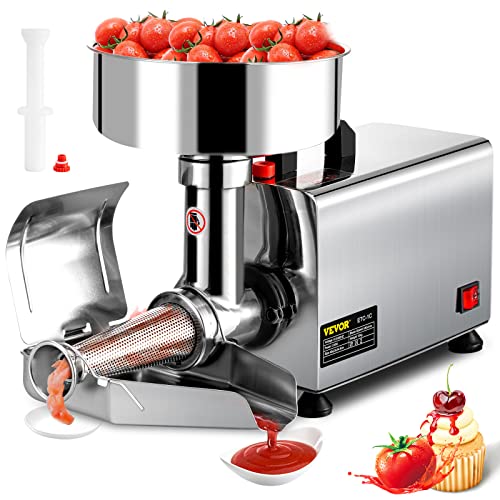
Commercial Stainless-Steel Workhorse – VBENLEM 370W Tomato Strainer
For tomato presses for small businesses that need powered production and easy cleanup, the VBENLEM 370W Tomato Strainer provides a commercial-grade-style stainless-steel design. Its 110-volt pure copper motor, 9-inch funnel, adjustable trough, and stated 90–160 kg/h range target steady sauce-making work.
Best For: Small sauce makers and food businesses processing tomatoes and other fruit into ketchup, sauces, or jams.
Pros:
- Uses a 370-watt pure copper motor with a 110-volt supply.
- Food-contact parts are specified as 304 stainless steel.
- Large 9-inch funnel supports continuous feeding.
- Adjustable discharge trough and trough brace help direct sauce and reduce splashing.
Cons:
- At 22 pounds and roughly 19.3 by 9.1 by 13.6 inches, it needs dedicated counter or storage space.
- The supplied notes list both a 90–160 kg/h range and a 100 kg capacity, so buyers should clarify what each figure represents.
- It is intended for 110-volt operation and may not suit other electrical systems.
This model offers a useful middle ground between manual mills and higher-capacity equipment, with practical cleaning and feeding features for a small sauce-production setup.
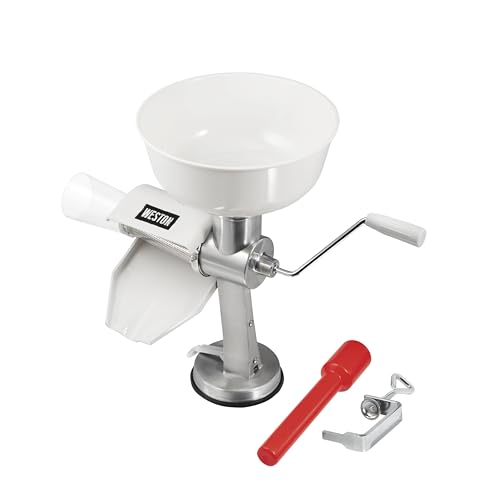
Best Compact Manual Pick – Weston Food Strainer and Sauce Maker
Weston Food Strainer and Sauce Maker for Tomato, Fresh Fruits and Vegetables ,White
Check Price On AmazonFor small businesses seeking tomato presses for small businesses without committing to an electric machine, the Weston Food Strainer and Sauce Maker offers a compact manual setup. Its 1-gallon hopper, 1.5 mm tomato screen, and dual-mount design support sauce preparation, preserving, and other small-batch food work.
Best For: Small-batch tomato sauce, canning, preserving, and multipurpose fruit or vegetable processing.
Pros:
- Separates tomato skins and seeds from pulp with a stainless steel 1.5 mm screen.
- Extra-large hopper holds approximately 1 gallon of produce.
- Dual mounting options include a suction cup base and C-clamp.
- Includes a stomper for applying pressure more safely.
Cons:
- Manual handle operation requires hands-on processing.
- Only the tomato screen is included; additional screens are available separately.
- Its listed 16-ounce weight may offer less heft than larger commercial machines.
The Weston is a practical choice when flexibility and a relatively compact footprint matter more than automated throughput. It is especially suited to businesses processing modest quantities of tomatoes or other soft produce.
Best for Everyday Use – 450W Electric Tomato Strainer
Among tomato presses for small businesses, this 450W electric tomato strainer is the throughput-focused option. Its automatic operation, 304 stainless steel food-contact parts, and stated 200–350 pounds-per-hour output are designed for larger sauce, jam, juice, and canning batches.
Best For: Small businesses and serious home canners processing large harvests or frequent batches of tomatoes and soft fruit.
Pros:
- 450W pure copper motor provides automatic processing with a stated 200–350 lbs/h output.
- 304 stainless steel food-contact components resist corrosion and support clean flavor handling.
- Large 8.5-inch feed chute supports continuous feeding.
- Detachable dishwasher-safe parts, tool-free assembly, anti-slip feet, and a waterproof switch simplify operation and cleanup.
Cons:
- At 20.9 pounds and nearly 21 inches long, it needs dedicated counter or storage space.
- Electric operation requires access to a 110V power source.
- Its higher capacity may be unnecessary for occasional small batches.
This machine makes the most sense when labor reduction and batch speed are priorities. The wide chute and automatic feed design should appeal to sauce makers, canners, and small food operations handling substantial seasonal volume.
Best Expandable Clamp Model – Johnny Apple Sauce Maker Model 250
For operations wanting a straightforward hand-crank press, the Johnny Apple Sauce Maker is a versatile choice among tomato presses for small businesses. The clamp-based Model 250 includes a 1.3 mm apple/tomato screen and can also process produce for purees, juices, jams, soups, and baby food.
Best For: Small businesses that want manual tomato processing with secure countertop mounting and optional motor upgrade potential.
Pros:
- Includes a 1.3 mm apple/tomato screen for separating skins and seeds.
- Clamp mounts to countertops from 3/4 to 2-1/8 inches thick.
- Long hand crank handle supports manual use, with an optional electric motor available separately.
- Includes BPA-free plastic components and a five-year warranty claim in the product bullets.
Cons:
- The electric motor is not included and must be purchased separately.
- Additional screens for salsa, pumpkin, and berries are also sold separately.
- Clamp mounting requires a suitable countertop within the stated thickness range.
The Johnny model offers a useful balance of affordability, versatility, and future expandability. Choose it when a manual workflow fits current production but an optional motor could become valuable as demand grows.
High-Volume Pick – VEVOR Electric Tomato Strainer
For small businesses comparing tomato presses for small businesses, the VEVOR Electric Tomato Strainer stands out for high-volume sauce and puree production. Its 370W motor, large hopper, and stated 200-lb-per-hour capacity are suited to busy harvest-season processing, while the stainless steel filter separates skins and seeds in one pass.
Best For: Small businesses processing large batches of tomatoes for sauce, puree, juice, or canning.
Pros:
- High stated processing capacity and a 370W motor support bulk production.
- Stainless steel screen separates peels and seeds for smoother results.
- Large hopper reduces refill frequency.
- Tool-free disassembly makes rinsing and cleanup easier.
Cons:
- Tomatoes should be cut into small pieces to help reduce clogging.
- At 21.7 pounds, it is less convenient to move frequently.
The VEVOR is the strongest fit here when throughput and repeated processing matter most. Its stainless steel food-contact components and straightforward cleanup also support frequent use, though operators should plan for a dedicated workspace.
Versatile Sauce-Making Pick – Weston Deluxe Electric Tomato Strainer
The Weston Deluxe is a practical option for small businesses that need tomato presses for small businesses but also make salsa, jelly, puree, or other preserved products. Its 250W motor, one-gallon hopper, reverse function, and three interchangeable stainless steel screens provide useful flexibility across recipes.
Best For: Small food businesses and preservation operations needing multiple texture options.
Pros:
- Three screens support fine tomato straining, larger purees, and chunky salsa.
- One-gallon hopper accommodates relatively large batches.
- Two speeds include reverse operation to help prevent jamming.
- Includes a stomper for feeding ingredients into the hopper.
Cons:
- Its 250W motor is less powerful than the VEVOR’s listed 370W motor.
- The housing combines plastic and stainless steel rather than being fully stainless steel.
The Weston is a well-rounded choice when product variety matters as much as tomato throughput. The interchangeable screens make it more adaptable than a single-purpose strainer, while the one-year warranty adds a defined period of coverage.
Multi-Use Compact Pick – AIRMSEN Meat Grinder and Tomato Press
The AIRMSEN is worth considering if your search for tomato presses for small businesses includes equipment that can handle more than tomatoes. It combines a tomato strainer with meat grinding, sausage-making, and kibbeh attachments, offering a compact, multi-function setup for kitchens with varied prep needs.
Best For: Small commercial or home-based food operations that need one appliance for tomato processing and meat preparation.
Pros:
- Four-in-one design covers tomato sauce, meat grinding, sausage, and kibbeh preparation.
- Three grinding plates provide 5mm, 7mm, and 12mm options.
- Reverse function helps clear stuck ingredients.
- Detachable parts and a safety-lock knob support straightforward operation.
Cons:
- Parts are not dishwasher safe and should be hand-washed.
- Tomato processing is one function within a broader meat-grinder design, rather than its sole purpose.
- Supplied specifications list 300 watts, so the advertised peak-power wording should not be treated as continuous operating wattage.
The AIRMSEN makes the most sense when space or budget favors one versatile appliance over a dedicated tomato press. It offers useful flexibility, but businesses focused primarily on high-volume tomato sauce may prefer the purpose-built VEVOR or Weston machines.
How We Picked the Best Tomato Presses for Small Businesses
We focused on the factors that matter most in small-scale commercial food preparation: processing capacity, motor power, construction, ease of operation, cleanup, versatility, and likely workload. The selection includes manual food mills for lower-volume batches and electric tomato presses designed for faster, more continuous processing.
We also considered whether each model separates skins and seeds, how much hands-on work it requires, and whether its design suits occasional production or repeated use during harvest and preserving seasons. Capacity claims can vary by tomato type, preparation, and operator, so treat advertised hourly output as a comparison point rather than a guarantee.
Quick Comparison
| Best For | Recommended Type | What to Prioritize |
|---|---|---|
| Small batches and occasional use | Manual food mill or clamp-style strainer | Stability, interchangeable screens, and easy cleaning |
| Regular sauce production | Compact electric strainer | Motor durability, feed-tube design, and parts availability |
| Higher-volume processing | Commercial-style electric mill | Throughput, stainless-steel components, and duty cycle |
| Multi-purpose kitchen work | Food mill or grinder-and-press combination | Attachments, control options, and cleanup requirements |
Key Buying Factors for Tomato Presses for Small Businesses
Capacity and Throughput
Estimate how many tomatoes you process per batch and how long your production window lasts. A manual press may be economical for a farm stand or small catering schedule, while an electric model is usually better when several crates must be processed quickly.
Motor Power and Duty Cycle
Wattage offers a useful baseline, but it does not tell the whole story. Look for a sturdy drive system, thermal protection, and clear guidance about continuous operation. A machine that requires frequent cooling may not suit a busy production day.
Materials and Food Contact Parts
Stainless-steel screens, hoppers, and augers generally offer better resistance to staining and corrosion than lower-grade materials. Confirm which parts are removable and whether they are dishwasher-safe before buying.
Yield, Texture, and Adjustability
Screen size and auger design affect sauce texture and pulp separation. If you make sauces, juices, jams, or purées, choose a model with suitable screens or adjustable separation rather than focusing only on speed.
Cleaning, Storage, and Support
Cleanup can determine whether a press saves labor or creates more of it. Favor simple disassembly, accessible replacement parts, secure clamps or feet, and a manufacturer that provides manuals and service information.
Who Should Buy Which Tomato Presses for Small Businesses?
Choose a manual mill if you process modest quantities, need portability, or want the lowest upfront cost. These models are useful when production is seasonal and storage space is limited.
Choose a compact electric press if you make sauce regularly and want to reduce repetitive hand work without stepping up to a large commercial machine.
Choose a higher-capacity electric model if your business processes large harvests, sells packaged sauce, or needs consistent output during concentrated production periods. Confirm electrical requirements, counter space, and cleaning procedures first.
Choose a combination grinder and press if your operation also prepares ground meat or other purées. The added versatility can justify the extra complexity when multiple functions will be used frequently.